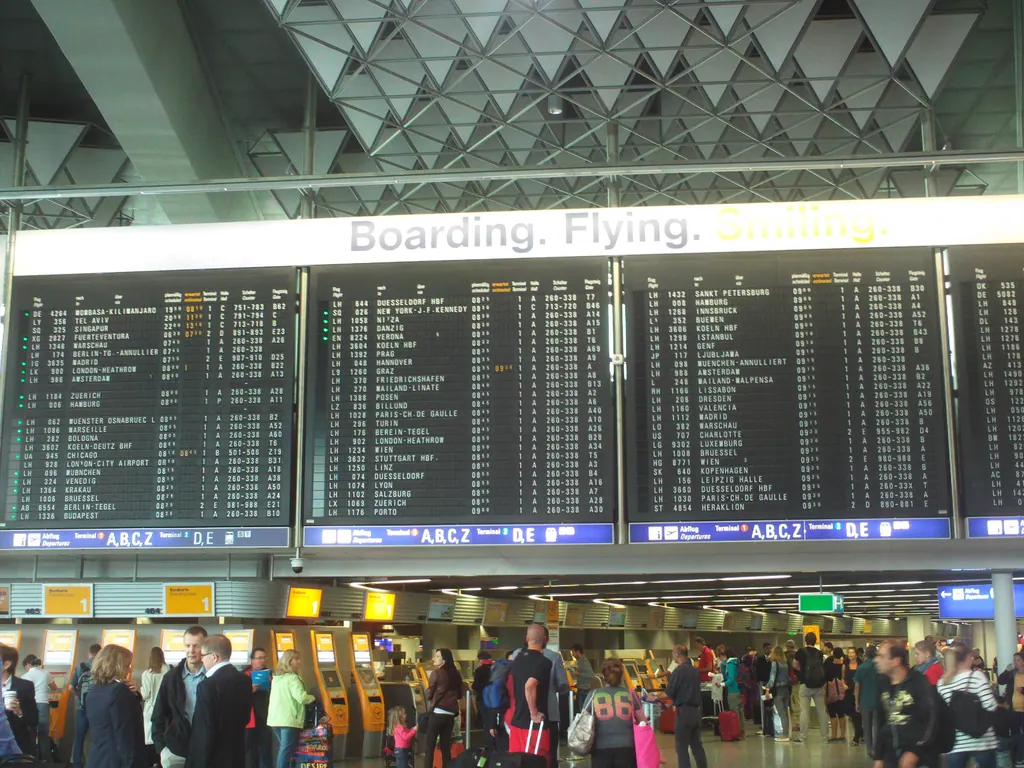
Your flight home from Rome is supposed to leave at 11:00. At 10:30 the gate agent announces a "technical issue." You finally land at JFK five hours late, tired, hungry and wondering whether anyone owes you anything.
Under U.S. rules, probably not much. Under European rules, quite possibly a fixed cash payment of up to 600 euros per passenger, on top of meals while you wait. That law is usually called EU261, after its number (Regulation (EC) No 261/2004), and it covers far more American travelers than most of them realize. Below we go through which flights qualify, how the amounts are set, what airlines are allowed to refuse, and how to file a claim. All rules are as checked on November 2, 2026, and currency conversions use the late October 2026 rate of about $1.12 per euro.
Which Flights Count?
The law does not care about your passport. It cares about where the flight departs and which airline operates it. According to the European Commission's Your Europe portal, you are covered on:
- Any flight departing from an EU airport, on any airline. A United, Delta or American flight from Paris, Madrid or Frankfurt to the U.S. is covered.
- Any flight within the EU, on any airline.
- Flights arriving in the EU from outside it, but only on an EU airline. Lufthansa, Air France, KLM, Iberia, ITA Airways, SAS and Aer Lingus count. A U.S. airline flying from New York to Rome does not.
That last point is the one Americans trip over. Your outbound flight to Europe on a U.S. carrier is usually outside the rules, while your return flight on the same carrier is covered, because it departs from the EU.
There is one more exception: if you already received compensation or assistance under the law of a non-EU country for the same disruption, the EU rules do not apply on top of it.
The rules also apply in Iceland, Norway and Switzerland, and in the EU's outermost regions, which include the Canary Islands, Madeira, the Azores, and the French Caribbean islands of Guadeloupe, Martinique, Saint-Martin and Saint Barthélemy. The Faroe Islands are not included. The United Kingdom left the EU and now has its own version of the same rules, usually called UK261, with the amounts set in pounds.
How Much Money Are We Talking About?
Compensation is a flat amount per passenger, based on distance, not on what you paid for the ticket. A $59 sale fare and a full business class ticket earn the same sum.
| Flight distance | Compensation | About in U.S. dollars (2026) |
|---|---|---|
| Up to 1,500 km (about 930 miles) | 250 euros | about $280 |
| Within the EU, over 1,500 km | 400 euros | about $450 |
| Other flights, 1,500 to 3,500 km (about 930 to 2,175 miles) | 400 euros | about $450 |
| Other flights, over 3,500 km (about 2,175 miles) | 600 euros | about $670 |
Practically every transatlantic flight is over 3,500 km. New York to Paris is roughly 5,800 km, so a long enough delay on that route means 600 euros each. A family of four on a delayed flight home from Europe could be looking at 2,400 euros (about $2,690 in 2026).
There is one discount built in. On flights over 3,500 km, if you reach your final destination between three and four hours late, the airline may cut the payment in half, to 300 euros (about $335 in 2026).
How Late Is Late Enough?
The trigger is a delay of three hours or more at your final destination, measured on arrival. Courts have interpreted arrival as the moment at least one aircraft door opens, not the moment the wheels touch the runway. A flight that leaves four hours late but makes up time in the air and arrives two hours and 50 minutes late earns nothing.
Cancellations work a little differently. If the airline cancels with less than 14 days' notice, you are usually entitled to compensation unless it offers you a replacement flight that keeps you close to your original schedule. You can also choose between a refund and rerouting.
Missed connections count too, if both flights were on one booking. If a late first leg makes you miss your connection and you reach your final destination more than three hours late, the whole trip is judged as a unit. Two separate tickets bought on your own do not get that protection, and neither does a connection missed because you were stuck in a security line.
What the Airline Can Refuse
Airlines do not have to pay compensation when the disruption was caused by extraordinary circumstances that could not have been avoided even with all reasonable measures. Your Europe lists examples like bad weather, air traffic control decisions, political instability and security risks.
What is usually not extraordinary, according to Your Europe and a long line of EU court rulings:
- Most technical problems with the aircraft, since maintenance is part of normal airline operations
- Strikes by the airline's own staff
- Crew shortages and scheduling problems
So the "technical issue" in Rome is exactly the kind of reason that often does lead to a payment. Expect the airline to argue otherwise at first. Many claims are paid only after the passenger pushes back.
Food, Hotels and Refunds While You Wait
Separately from compensation, the airline must take care of you during long delays, and these duties apply even in extraordinary circumstances like storms. You are entitled to meals and refreshments and a way to communicate once you have waited:
- 2 hours or more on flights up to 1,500 km
- 3 hours or more on flights of 1,500 to 3,500 km
- 4 hours or more on longer flights
If the new departure is the next day, the airline must also provide a hotel and transport to it. Once a delay reaches five hours, you can give up the trip and ask for a full refund of the ticket.
If the airline does not hand out vouchers, buy reasonable meals yourself and keep every receipt. Airlines tend to repay sensible costs and push back on the 90-euro bottle of wine.
How to File a Claim
- Collect evidence at the airport. Photograph the departure board, keep your boarding pass and ask the staff to state the reason for the delay. Write down your actual arrival time.
- Claim directly with the airline. Most airlines have an online form for EU261 compensation. Name the regulation, the flight number, the date and the amount you are claiming.
- Escalate if you get no answer or a refusal. If the airline does not reply within two months, or you disagree with its answer, you can complain to the national enforcement body in the EU country where the incident happened.
- Go to court if needed. For claims up to 5,000 euros, the European Small Claims Procedure is designed to work without a lawyer, in writing, across borders.
The deadline for claiming is set by national law and varies a lot between countries, from about one year to several years. Claim quickly anyway, while your documents are easy to find.
Claim companies will do the work for a share of the money, often somewhere between a quarter and a third of the payout. That can make sense for a stubborn case, but for a straightforward delay, the airline's own form costs nothing.
How Does This Compare With U.S. Rules?
At home, the picture is thinner. Since 2024, the U.S. Department of Transportation requires automatic cash refunds when a flight is canceled or significantly changed and you choose not to travel. For domestic flights, a significant change includes a departure or arrival moved by three hours or more, and for international flights six hours or more.
There is no federal rule that pays cash compensation for a delay itself. DOT had proposed one, but withdrew that proposal in November 2025. Some U.S. airlines offer meal vouchers or miles voluntarily, but that is policy, not law.
That gap is why EU261 is worth knowing about even if you only fly to Europe once a year. If you are planning a longer trip, our guide to tipping in Europe covers another set of rules that work differently from home, and you can find more practical guides under flights.
Changes Coming in 2027
The EU has updated the law. The new regulation, Regulation (EU) 2026/2202, entered into force on October 22, 2026, but most of it only applies from October 23, 2027. Until then, the current rules described above apply.
According to the published text, the three-hour threshold and the 250, 400 and 600 euro amounts stay the same. Distance will be measured from the first departure airport to the final destination, and the law will include a list of what counts as extraordinary circumstances, which should mean fewer arguments about the reasons for a delay. Check the details again before any trip after October 2027.
Frequently asked questions
Does EU261 apply to U.S. airlines?
Yes, on flights departing from an EU airport. A U.S. airline flying from Paris to New York is covered, but the same airline flying from New York to Paris is not, because only EU airlines are covered on flights into the EU.
How much compensation can I get for a delayed flight from Europe to the U.S.?
Up to 600 euros (about $670 in 2026) per passenger if you arrive three hours or more late. If you arrive between three and four hours late on such a long flight, the airline may halve it to 300 euros.
Do I get compensation if the delay was caused by weather?
No. Bad weather counts as an extraordinary circumstance. The airline must still provide meals, and a hotel if you have to wait until the next day.
Does EU261 cover flights from the UK?
Not since Brexit. The UK has its own almost identical rules, usually called UK261, with the amounts set in pounds.
Do Americans get compensation for flight delays in the U.S.?
There is no federal rule requiring cash compensation for delays. You are entitled to an automatic refund if a flight is canceled or significantly changed and you choose not to travel.