Most landings are forgettable. You finish your drink, the wheels touch, someone's phone pings, and that is that. But on a short list of airports around the world, the last two minutes of the flight are the reason people book the ticket. The runway sits on a beach, or hangs off a cliff, or appears between mountain walls only seconds before touchdown.
We have gathered nine approaches that frequent flyers, pilots and plane spotters keep coming back to. Some are famous because they look dramatic from the ground, others because they are demanding from the cockpit, and a few because the view from a window seat is simply hard to beat. All of them can be flown as an ordinary paying passenger.
What Makes a Landing Worth Flying For?
Three things come up again and again. The first is setting: water, sand, peaks or a city spread out right below the wing. The second is runway length, because a short strip calls for small aircraft, steep descents and firm braking. The third is terrain: mountains or hills that rule out a long, straight approach and make pilots fly a curved, visual path instead.
A few practical notes before you book. On small aircraft, seats are often unassigned, so arriving early at the gate can help you get a window. On larger jets, the side of the plane matters, and plane spotters share notes online about which side faces the view on each approach. And weather is the great equalizer: low clouds can hide the scenery entirely, and strong winds can cause diversions at several of the airports below.
Barra, Scotland: A Runway That Disappears Twice a Day
On the island of Barra in the Outer Hebrides, flights from Glasgow land on the sand of Traigh Mhòr, a wide, shallow bay. According to Highlands and Islands Airports, the operator, Barra is the only airport in the world where scheduled flights use a tidal beach as the runway. Three runways are marked out in a triangle with wooden posts, so the plane can almost always land into the wind, and all of them vanish under the sea at high tide.
That means the timetable follows the tides. Loganair flies the route with 19-seat Twin Otter aircraft, and flight times shift from day to day. When the windsocks are down and the airport is closed, the "runway" goes back to being a public beach for walkers and families. Scheduled flights to Barra have operated since 1936.
Saba, Caribbean Netherlands: The Shortest Commercial Runway
Saba is a steep volcanic island in the northeastern Caribbean, and its airport fills almost the only flat piece of land there is. The runway at Juancho E. Yrausquin Airport is about 1,312 feet (400 m) long, which Guinness World Records lists as the shortest commercially serviceable runway in the world. Cliffs drop to the sea at both ends, and high ground rises on one side.
Jets cannot land here. The island is served by short takeoff and landing propeller aircraft, typically from nearby Sint Maarten, and the flight is so short that the approach is most of the experience. The wind decides which end of the runway you land on, so each arrival is a little different.
St. Barts: Over the Hill and Down to the Beach
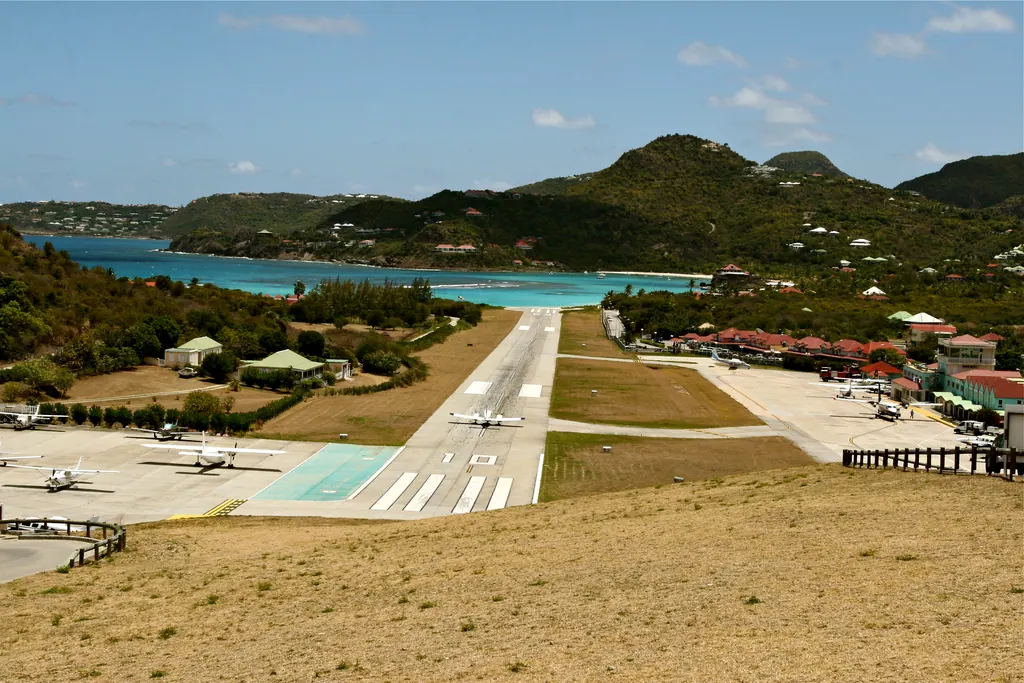
On St. Barthélemy (St. Barts), the approach to Gustaf III Airport crosses a ridge at the Col de la Tourmente, where a road and a roundabout sit just below the descending aircraft. The plane then drops steeply onto a runway of roughly 2,130 feet (650 m) that ends at the sand of St. Jean Beach.
French aviation rules require pilots to complete specific training before flying into St. Barts, and only small aircraft are used. Most visitors connect through Sint Maarten or another nearby island. The hill at the Col de la Tourmente is also a popular place to watch landings from the ground.
Sint Maarten: The Beach Under the Wing
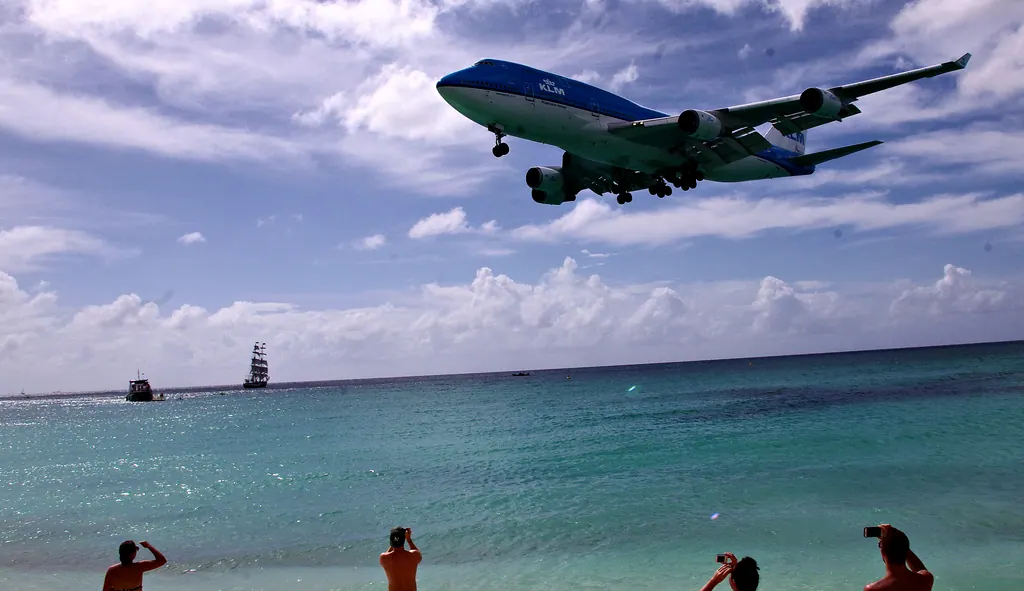
Princess Juliana International Airport on the Dutch side of Sint Maarten is probably the most photographed approach in the world. Arriving aircraft cross Maho Beach just above the sunbathers before touching down. From the window seat, you see turquoise water, a strip of white sand and a crowd of upturned faces.
The beach comes with a serious warning. Departing jets blast the beach with exhaust, and signs warn that it can cause severe injury or death. In 2017, a visitor died after being thrown by jet blast while holding on to the airport fence. If you go to watch the planes, stay well away from the fence when aircraft are taking off.
Sint Maarten is also one of the Caribbean's main connecting hubs, with nonstop service from several U.S. cities, which makes it an easy add-on to a trip. Our guide Which Caribbean Island Is Right for You? can help you decide where to go next.
Madeira, Portugal: A Runway on 180 Columns
Madeira's airport near Funchal was once known for a very short runway squeezed between mountains and the Atlantic. In 2000, the runway was extended to about 9,124 feet (2,781 m), partly on a platform built out over the shoreline and supported by 180 concrete columns. Guinness World Records lists it as the airport with the longest bridge-supported runway extension in the world.
The approach still has a reputation. Strong and shifting winds off the mountains can cause go-arounds and diversions, and arriving aircraft often fly along the coast before turning in to land, giving passengers a long look at the cliffs and the ocean. In 2017 the airport was renamed after footballer Cristiano Ronaldo, a Madeira native.
Gibraltar: Where a Road Crossed the Runway
Gibraltar's runway was built in 1941 across Winston Churchill Avenue, the road linking the territory with Spain, and for decades traffic had to stop every time a plane landed or took off. Since March 31, 2023, cars have used a new tunnel instead, but pedestrians and cyclists can still cross the runway when it is open, according to the Government of Gibraltar.
From the air, the view is the reason to come. The approach brings you right past the Rock of Gibraltar, with the bay and the Spanish coast on one side and the Mediterranean on the other. Crosswinds around the Rock can be strong, especially in winter.
Paro, Bhutan: Threading a Himalayan Valley
Paro International Airport sits at about 7,364 feet (2,245 m) in a narrow valley, with surrounding peaks rising to around 18,000 feet (5,500 m). Aircraft fly a visual approach along the valley and make tight turns before the runway comes into view, only moments before landing. Only specially trained pilots are certified to fly here, and the number most often cited is around 50.
Flights operate in daylight, and weather can delay them. If you are heading to Bhutan, the views of terraced fields, farmhouses and forested ridges from the window are an excellent first impression of the country.
Queenstown, New Zealand: Mountains on Both Sides
Queenstown sits on Lake Wakatipu on New Zealand's South Island, surrounded by peaks including the Remarkables. Aircraft fly through valleys and around high terrain to reach a runway of about 6,200 feet (1,890 m), and on a clear day the scenery is extraordinary. There are no nonstop flights from the U.S., so most American travelers connect in Auckland or an Australian city.
If you are planning a South Island trip, our guide to New Zealand's South Island covers what to see once you land.
Lukla, Nepal: The Gateway to Everest
For trekkers bound for Everest Base Camp, the flight from Kathmandu to Lukla is a rite of passage. Tenzing-Hillary Airport sits at about 9,334 feet (2,845 m), and its runway is only about 1,729 feet (527 m) long with a steep uphill slope of around 11.7 percent, which helps aircraft slow down on landing. There is a mountainside at one end and a steep drop at the other, so there is no room for a second attempt.
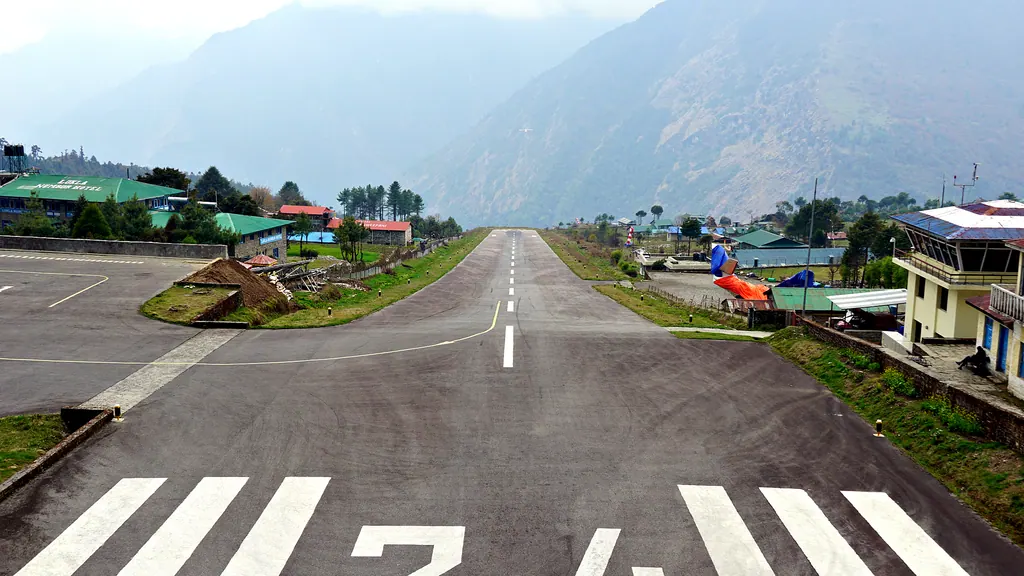
Lukla is one of the more demanding airports on this list, and flights are often delayed or canceled by weather. Build extra days into your itinerary if you are flying in for a trek. Our guide to trekking in Nepal explains how the season affects the trails.
How to Get the Best View on Your Flight
- Choose the right side. For each approach, the scenery is usually on one side. Plane spotter forums often explain which.
- Fly in the morning. In mountain areas, mornings are often calmer and clearer than afternoons.
- Keep your plans flexible. At airports like Lukla, Paro, Madeira and Barra, weather can delay or cancel flights. Leave buffer days before onward connections.
- Watch from the ground, too. Several of these airports have public viewpoints. Respect the barriers and warning signs.
- Book small aircraft early. Routes like Barra, Saba and St. Barts use small planes with limited seats.
For more practical flight advice, see our take on red-eye flights and the rest of our flights section.
Frequently asked questions
Which airport has the shortest commercial runway in the world?
Juancho E. Yrausquin Airport on the Caribbean island of Saba, with a runway of about 1,312 feet (400 m), according to Guinness World Records.
Where do planes land on a beach?
At Barra in Scotland's Outer Hebrides, scheduled Loganair flights from Glasgow land on the sand of Traigh Mhòr. Flight times follow the tides.
Is it safe to watch planes at Maho Beach?
Watching landings is popular, but jet blast from departing aircraft is dangerous. Stay away from the airport fence during takeoffs and follow the warning signs.
Why can only some pilots land at Paro in Bhutan?
The approach through a narrow Himalayan valley is flown visually with tight turns, so pilots need special training and certification. Around 50 pilots are often cited as qualified.
- Highlands and Islands Airports: Barra Airport information
- Guinness World Records: Shortest commercially serviceable runway
- Guinness World Records: Airport with the longest bridge-supported runway extension
- Government of Gibraltar: Airport Tunnel to open on 31st March 2023
- Department of Air Transport, Bhutan: Paro International Airport