Most visitors see Latvia through a single window: Riga's Old Town, its Art Nouveau facades and its Christmas market. Then they board a bus to Tallinn or Vilnius and move on.
That leaves out most of the country. Latvia is small, roughly the size of West Virginia, and almost everything worth seeing outside the capital is within a two- or three-hour drive. There are medieval castles above a river valley, a baroque palace designed by the architect behind St. Petersburg's Winter Palace, a beach town with wooden villas and a waterfall that is wider than it is tall by a factor of about a hundred. Here are seven places that make the trip out of Riga worthwhile.
1. Sigulda and the Gauja Valley
About an hour northeast of Riga by train, Sigulda is the gateway to Gauja National Park, Latvia's oldest and largest national park. It was founded in 1973 and covers more than 90,000 hectares (about 350 square miles) of pine forest, sandstone cliffs and river valley.
The highlight is Turaida, a red brick castle whose construction began in 1214. Its tower rises above the treetops, and the museum reserve around it includes a church, a sculpture garden and walking paths. Across the valley stand the ruins of Sigulda's medieval castle, and the river itself is good for canoeing in summer. In early October, the forests turn gold and red, and the valley is at its most photogenic.
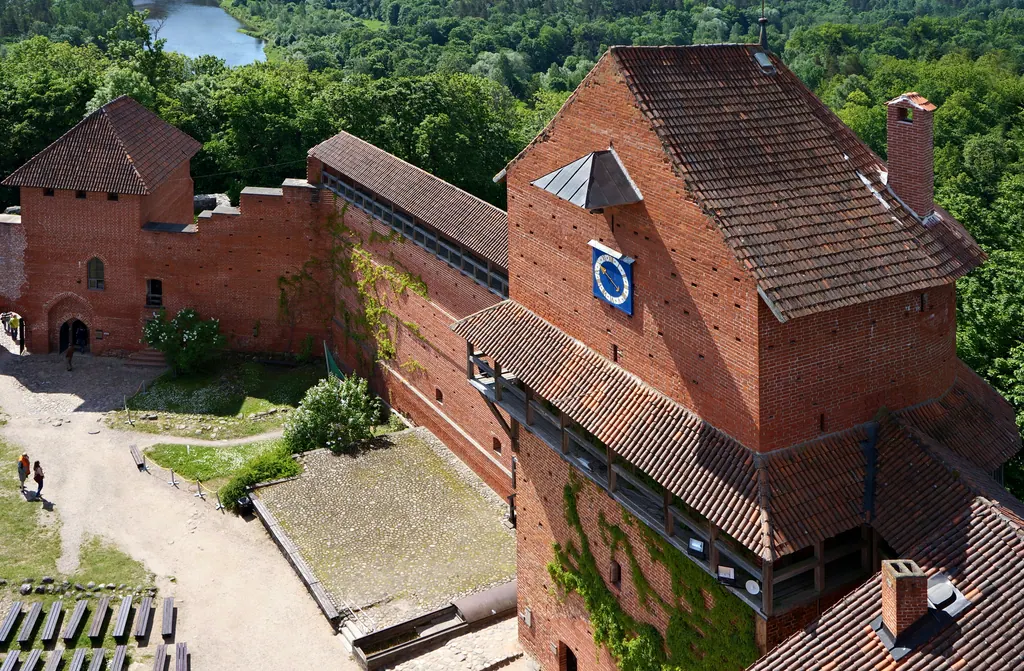
2. Cēsis, a Castle Town With Atmosphere
Further up the same valley, Cēsis is one of Latvia's best preserved small towns. Its medieval castle, once a stronghold of the Livonian Order, is partly a ruin you can explore by lantern light and partly a later manor house with a museum. The cobbled streets around it are quiet and lined with low wooden and stone houses. Cēsis works well as an overnight stop if you want to explore Gauja National Park at a slower pace.
3. Rundāle Palace
About 50 miles (80 km) south of Riga, close to the Lithuanian border, the fields open up and a yellow and white palace appears in the middle of the countryside. Rundāle Palace was designed by Francesco Bartolomeo Rastrelli, the Italian architect who later built the Winter Palace in St. Petersburg. Construction began in 1736 and was completed in two stages, ending in 1768.
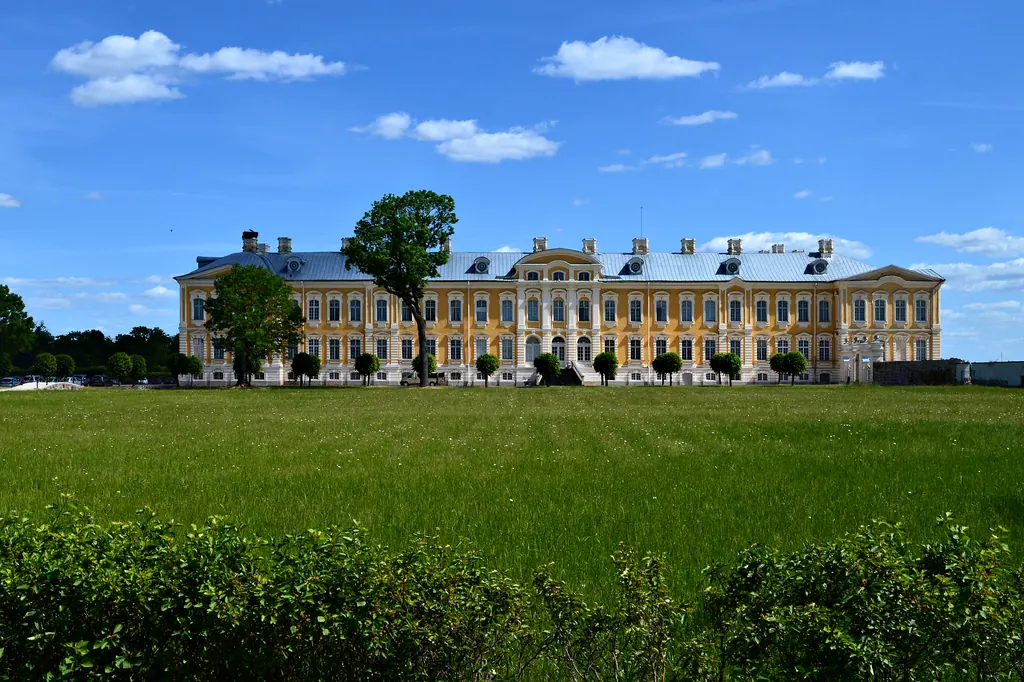
Inside, the state rooms are a blaze of gilding, stucco and painted ceilings. Outside, a French formal garden with a rose garden stretches behind the palace. It is an easy half-day trip by car, and many Riga tour operators offer it as a day tour, sometimes combined with Bauska Castle nearby.
4. Jūrmala, Riga's Beach Town
Latvians have been escaping to Jūrmala for summer since the 19th century. The resort stretches along the Gulf of Riga, with a beach of fine quartz sand that runs for about 15 miles (24 km). Trains from Riga Central Station reach Majori, the town's pedestrian center, in roughly half an hour.
Even outside the swimming season, Jūrmala is worth a walk. The streets behind the dunes are lined with wooden villas with carved verandas and turrets, many of them from the late 1800s and early 1900s.
5. The Great Ķemeri Bog Boardwalk
At the western end of Jūrmala, Ķemeri National Park protects one of the most unusual landscapes in the Baltics: a raised bog of moss, small pools and stunted pines. A wooden boardwalk leads across it, and according to Jūrmala's tourist office it is free and open all year, with a short loop of about 1 mile (1.5 km) and a longer one of about 2 miles (3.5 km). Go early in the morning or at sunset, when mist hangs over the pools and the light turns soft.
6. Kuldīga and Europe's Widest Waterfall
If you only have time for one longer trip, make it Kuldīga, about 95 miles (150 km) west of Riga. Its old town of wooden houses, red tile roofs and a small river running between the buildings was added to UNESCO's World Heritage List in 2023.
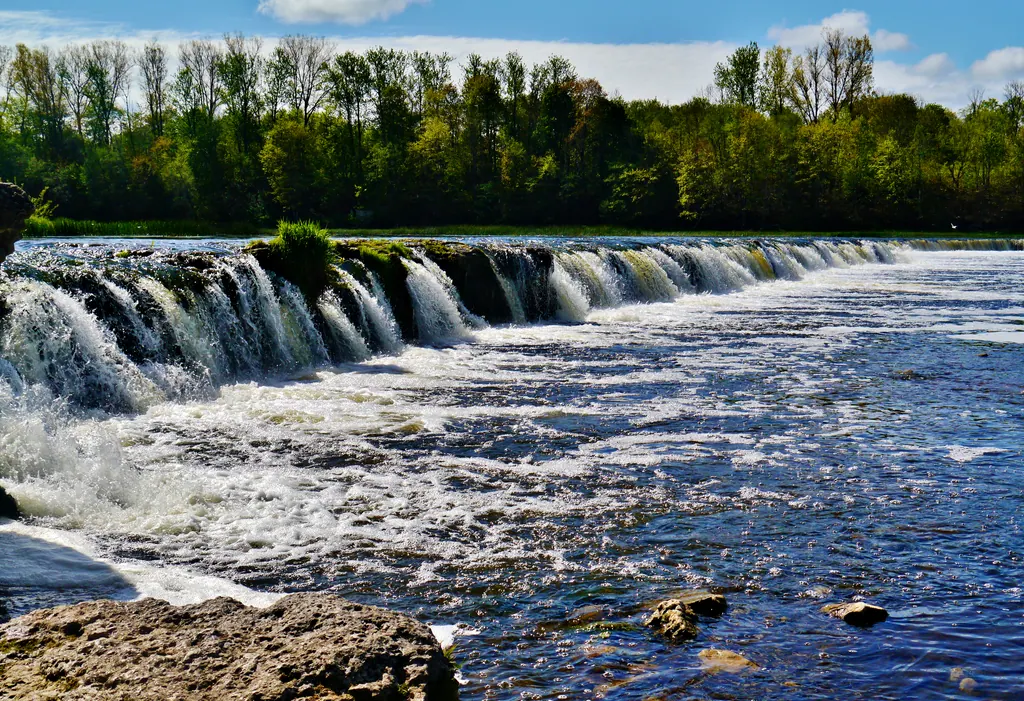
Kuldīga's best-known sight is the Venta Rapid (Ventas Rumba), widely described as the widest natural waterfall in Europe. It is about 249 meters (about 817 feet) wide, but only around 6 feet (about 2 m) high. In spring, fish leap up the falls on their way upstream, and on warm summer days people wade across the shallow ledge. A long red brick bridge from 1874 crosses the river just below it and is one of the best viewpoints.
7. Liepāja and the Karosta Quarter
On the Baltic coast in the far west, Liepāja is Latvia's third largest city and has a reputation for music and a wide, sandy city beach. Its most memorable corner is Karosta, a former military port built under the Russian Empire and later used by the Soviet navy. The district still has an onion-domed naval cathedral and, on the beach, the broken concrete of the Northern Forts sinking into the sea. It is a striking, slightly melancholy place, and a reminder of how recent Latvia's independence is.
Getting Around Outside Riga
- By train: Latvia's passenger trains (Vivi) run from Riga to Sigulda, Cēsis and Jūrmala, and are cheap and easy to use. The trip to Sigulda takes a little over an hour on most departures.
- By bus: Kuldīga, Rundāle and Liepāja are easier to reach by bus or car than by train.
- By car: A rental car makes it possible to combine Rundāle, Kuldīga and the coast in two or three days. Roads are generally good and traffic outside Riga is light.
- Money: Latvia uses the euro. A day trip to Rundāle by car costs little beyond fuel and the palace ticket.
How to Fit It Into a Trip
With one extra day, choose Sigulda or Rundāle. With two, add Jūrmala and the Ķemeri boardwalk on a separate half-day. With three or four, drive west to Kuldīga and Liepāja and return along the coast.
If you are combining Latvia with its neighbors, our Baltic road trip from Vilnius to Tallinn passes right through the Gauja valley, and our guide to the Baltic Christmas markets covers Riga in December. You will find more on our Latvia page and the rest of Europe.
Frequently asked questions
What is worth seeing in Latvia outside Riga?
Sigulda and Gauja National Park, the castle town of Cēsis, Rundāle Palace, the beach town of Jūrmala, the Ķemeri bog boardwalk, Kuldīga and the Karosta quarter in Liepāja.
Can you do a day trip from Riga to Sigulda by train?
Yes. Trains from Riga reach Sigulda in a little over an hour on most departures, which makes it an easy day trip.
What is the widest waterfall in Europe?
The Venta Rapid in Kuldīga, Latvia, is widely described as Europe's widest natural waterfall at about 249 meters (817 feet), though it is only around 2 meters high.