Every trekker who passes through Kathmandu ends up in the same lanes of Thamel, squeezing between racks of down jackets, stacks of singing bowls and walls of brightly colored scarves, each one labeled "pashmina." Shopkeepers call out from doorways, prices start high, and it is hard to tell which of the thousand nearly identical shops is worth your time.
Nepal is one of the best places in Asia to buy handmade things, but the good stuff is rarely the first thing you see. The country's real craft traditions live in the old Newar towns of the Kathmandu Valley, in Tibetan refugee workshops and in tea gardens far to the east. Here is where to go, what to look for, and how to bring it home without trouble.
Thamel: what is real and what is not?
Thamel is the tourist district of Kathmandu and the place most visitors do most of their shopping, if only because it is where they sleep. It is also the capital of the counterfeit outdoor jacket. Most of the "North Face," "Mountain Hardwear" and "Arc'teryx" gear on the street is made locally or imported cheaply, and nobody really pretends otherwise. Prices reflect it: a fake down jacket costs a fraction of the real one.
That does not make it useless. Many trekkers happily buy fake fleece, trekking pants, beanies, gloves, duffel bags and trekking poles for a teahouse trek, and rent a down jacket and sleeping bag rather than buy them. The rule of thumb is simple: buy cheap where failure is an inconvenience, and bring or buy genuine gear where failure is dangerous. Boots, waterproof shells for serious weather, crampons and anything for climbing should be the real thing. Check the stitching, the zippers and the spelling on the labels, and lower your expectations of how long the fake down will stay warm.
If you want the real brands, official stores for The North Face and Mountain Hardwear sit on Tridevi Marg at the edge of Thamel. The North Face store sells warranty-backed gear, at prices far above the street shops. There are also local brands that make honest, unbranded gear at fair prices. Our Nepal trekking guide covers what you actually need for each route.
The pashmina question
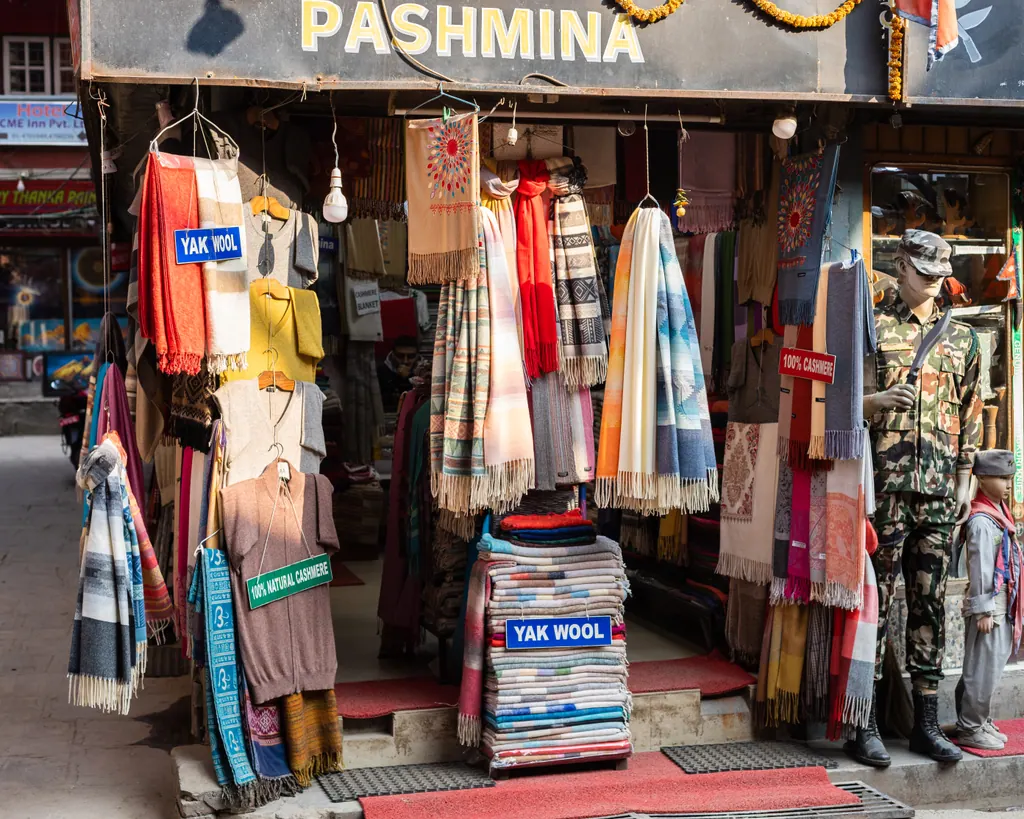
Pashmina is the fine underfleece of the chyangra, the Himalayan mountain goat. Much of what is sold as pashmina in Thamel is acrylic, viscose or ordinary wool. Price is the first clue: a scarf offered for 500-1,000 rupees (about $4-7) is not genuine cashmere, whatever the label says.
The Nepal Pashmina Industries Association has registered a collective trademark, Chyangra Pashmina, and member producers that meet its standards can attach the label, which by 2018 was recognized in 47 countries. Look for that label, buy from shops that will tell you the exact blend, and be suspicious of any thin shawl sold as "100 percent pashmina" at a bargain price. A pashmina and silk blend is a legitimate product; the silk adds strength and sheen. What matters is that the seller tells you what it is.
Asan and Indra Chowk: where Kathmandu shops for itself
Walk 10-15 minutes south of Thamel and the tourist shops give way to the old market streets of Asan and Indra Chowk. This is where Kathmandu buys spices, rice, brass pots, fabric and wedding supplies, along the old trade route that once linked India and Tibet. There are few souvenirs aimed at visitors, which is exactly the point.
In Indra Chowk, look for the bead market, where traders sell strands of tiny glass beads (pote) and string them into necklaces while you wait. Green and red bead necklaces are worn by many married Hindu women in Nepal, so this is a working market, not a show. Nearby lanes sell copper and brass cooking pots, bolts of cloth and dhaka, the patterned woven fabric used for the traditional Nepali cap, the dhaka topi. Dhaka cloth is closely associated with Palpa district in western Nepal and makes a light, easy souvenir.
Go in the morning, when the vegetable sellers set up in Asan, and keep your bag in front of you in the crowds.
Patan: metal Buddhas and fair-trade shops
Patan, officially Lalitpur, is the place to see Nepal's most respected craft: Newar metalwork. For centuries Newar families of the Shakya caste in Patan have cast statues of Buddhist and Hindu deities in copper alloys using the lost wax method. The sculptor models the figure in wax, encases it in clay, melts the wax out and pours in molten metal. Then other specialists engrave the details and often gild the surface. Large figures and temple decorations are more often made with repoussé, hammering sheet metal from behind, a technique many craftsmen consider harder than casting.
Workshops and showrooms fill the lanes around Patan Durbar Square, from the Golden Temple (Kwa Bahal) in the north to Uku Bahal in the south, long a center of bronze casting. A small, well-finished cast statue can cost a few thousand rupees; a large gilded figure from a known workshop can run to hundreds of thousands. Look at the face and the hands, which take the most skill, and ask whether the piece is cast in one piece or assembled. Entry to the Durbar Square area costs foreign visitors around 1,000 rupees (about $7) in 2026 (show your passport and the ticket can be extended for a week), and the Patan Museum inside the old palace is the best place in the country to calibrate your eye before you buy.
Patan is also the center of Nepal's fair-trade scene. Mahaguthi, founded in 1984 and a member of the World Fair Trade Organization, has a shop at Kupondole, the road that climbs from the Bagmati River into Patan. Dhukuti, the shop of the Association for Craft Producers, sells textiles, ceramics, felt and metalwork from rural producers, most of them women. Both have fixed prices, which is a relief after a day of haggling, and they are good places to find lokta paper, handwoven bags and knitwear.
Just south of the center, the Jawalakhel Handicraft Centre was founded in 1960 with Swiss support to give Tibetan refugees work. You can watch carpets being knotted by hand before shopping upstairs, where prices are set per square meter and shipping can be arranged.
Bhaktapur: potters and woodcarvers
Bhaktapur is the best preserved of the three old royal cities of the valley, and its crafts are made in front of you. The main Pottery Square, at Talako, lies a few minutes southwest of Taumadhi Square. Potters throw pots on wooden wheels, and the square is covered in clay vessels drying in the sun before firing. You can buy bowls, oil lamps, piggy banks and small animal figures directly from the people who make them, usually for a few hundred rupees.
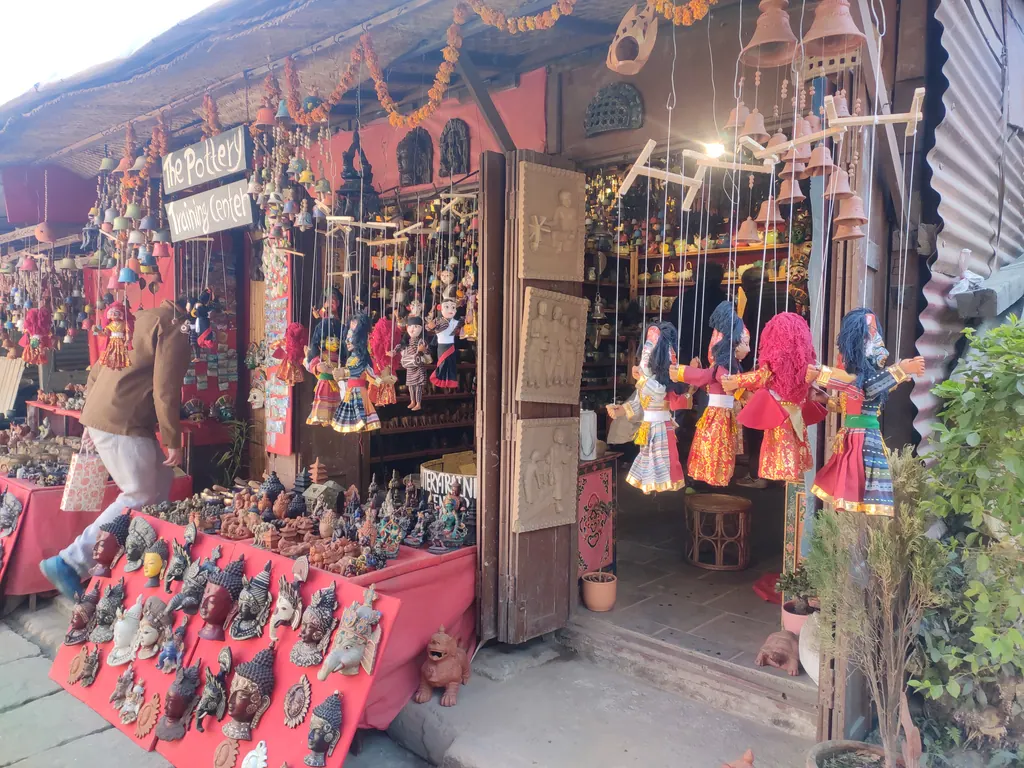
Woodcarving is the other Bhaktapur specialty. The town is famous for its carved windows and temple struts, especially the Peacock Window near Dattatreya Square, and the shops nearby sell miniature replicas of carved windows, masks and wooden puppets. Real carving is crisp and deep; cheap pieces are shallow and often finished with a dark stain to hide rough work.
Foreign visitors pay an entry fee of around 1,800 rupees (about $13) in 2026 for the old town, and the ticket covers repeat visits over several days. The fee goes toward restoration, and Bhaktapur deserves a full day.
How do you judge a thangka?
Thangkas, Buddhist paintings on cotton, are sold everywhere from Thamel to Boudhanath, and the quality range is enormous. Many shops call themselves thangka schools and do have students painting at the back, which is genuine, but the student work is priced accordingly.
A few things separate a good thangka from a decorative one:
- Fine lines and detail. Look at the faces, hands and the tiny figures in the background with your phone's magnifier. Master work has clean, even lines and smooth shading, even in the smallest areas.
- Gold. Good thangkas use real gold, often 24 karat, which has a soft glow rather than a brassy shine. Some schools grade their work openly: students paint without gold, intermediate painters use lower karat gold, and masters use 24 karat.
- Pigments. Traditional paint is made from ground minerals such as malachite and lapis lazuli. Cheaper works use acrylic, which looks flatter and brighter.
- Correct iconography. Each deity has prescribed colors, proportions and objects. A good seller can tell you who is depicted and what the details mean.
As a rough guide in 2026, small student thangkas start at a few thousand rupees (about $20-40), while large master paintings that took months can cost 100,000 rupees (about $715) or more. Ask how long the painting took, and walk away from anyone who will not let you look closely in good light.
Singing bowls
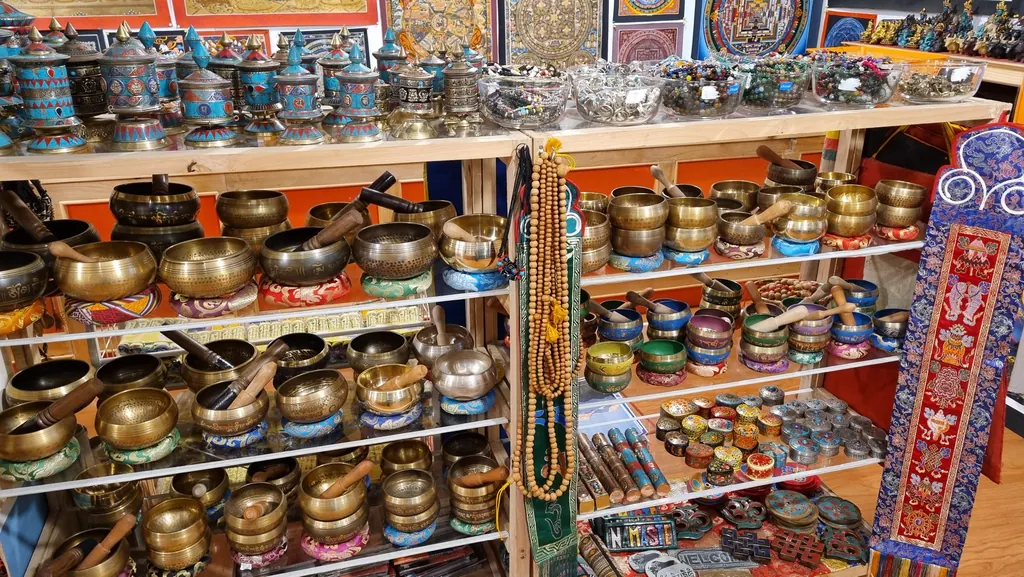
The same rule applies to singing bowls. A hand-hammered bowl has irregular dimples of different sizes and is rarely a perfect circle; a machine-made bowl is smooth or shows even lathe lines. Most handmade bowls are bell bronze, and the "seven metals" story told in many shops is mostly sales talk. Buy the bowl whose sound you like, and do not pay a premium for claims about age or planets. Small machine-made bowls often sell for 1,000-2,000 rupees (about $7-14), while large hand-hammered bowls cost many times more.
Pokhara, Namche Bazaar and beyond
Pokhara. The Lakeside strip along Phewa Lake has the same mix as Thamel, on a smaller scale: trekking gear for the Annapurna routes, scarves, jewelry and books. More interesting are the Tibetan settlements around the city. Tashiling, near Devi's Fall, and Tashi Palkhel, the largest, on the road north toward Baglung, both have handicraft centers where carpets are woven, and residents sell jewelry and other crafts directly.
Namche Bazaar. The main trading town of the Everest region has shops selling trekking gear, often at prices not far above Kathmandu's, plus prayer flags, singing bowls and Buddhist ritual objects. On Saturday mornings a weekly market fills terraces on the edge of town, where lowland traders sell rice and supplies and Tibetan traders sell goods carried over the mountains. It is a good place to watch, less a place for souvenirs. Anything you buy here you carry, so the best purchase is often a pair of warm socks you forgot.
Ilam tea. Nepal's first tea estate was planted in Ilam, in the far east next to Darjeeling, around 1863. Ilam and the neighboring hills grow orthodox tea in the same style as Darjeeling, often for a lower price. You do not need to go there to buy it: tea shops in Kathmandu and Pokhara sell first and second flush teas from named gardens. Since 2020 qualifying producers can use the trademark "Nepal Tea, Quality from the Himalaya." Tea is light, cheap to post and one of the most useful gifts to bring home.
Smaller stops. In Lumbini, the birthplace of the Buddha, the stalls around the Sacred Garden sell prayer beads, statues and books, mostly the same items you find in Kathmandu. Bandipur, a preserved Newar hill town between Kathmandu and Pokhara, has a handful of craft shops but is better for walking than shopping.
How hard should you bargain?
Bargaining is normal in markets and in most souvenir shops in Thamel, Patan and Bhaktapur. It is not expected in fair-trade shops, supermarkets, branded gear stores or anywhere with printed price tags.
A few habits make it easier:
- Know your number first. Visit two or three shops before you start negotiating, so you know the range.
- Start low but not insultingly low. Many travelers counter at around half the first price and settle somewhere in between. Opening prices for tourists in Thamel can be two or three times the final price.
- Keep it friendly. A smile and humor get you further than hard pressure. The amounts are often small for you and meaningful for the seller.
- Only bargain if you intend to buy. Once a price is agreed, walking away is considered rude.
- Carry cash. Many shops add a fee for cards, often a few percent. ATMs in Thamel and Lakeside are easy to find.
What can you take out of Nepal?
Modern handicrafts, textiles and clothing can be taken home without problems. Antiques are another matter. Nepal's Ancient Monuments Preservation Act protects archaeological objects, which in practice means items more than 100 years old, and they cannot be exported without permission from the Department of Archaeology in Kathmandu.
Because many new statues, bowls and masks are artificially aged to look old, customs officers may question them. For anything that looks antique, ask the shop for a receipt and a certificate stating that the item is not an antique, or have it cleared by the Department of Archaeology at Ram Shah Path in Kathmandu before you fly. Reputable dealers in Patan are used to the paperwork. If someone offers you a "genuine old" statue at a suspicious price, it is either fake or something you should not be buying.
Two other practical points. A khukuri, the curved Gurkha knife, must go in checked luggage. Carpets and large statues are heavy, and the shops that sell them can usually arrange shipping; get the shipping terms in writing.
A simple shopping plan for Kathmandu Valley
If you only have a couple of days, do your serious shopping in the old towns rather than Thamel. Spend a morning in Asan and Indra Chowk for beads, fabric and the city's everyday trade. Give Patan an afternoon for metalwork, Jawalakhel carpets and the fair-trade shops at Kupondole. Spend a full day in Bhaktapur for pottery and woodcarving. Then return to Thamel only for trekking gear and last-minute gifts, with a much better idea of what things should cost. For more ideas, see our shopping guides and practical travel tips.
Frequently asked questions
Is it safe to buy fake trekking gear in Kathmandu?
For a teahouse trek, fake fleece, pants, hats, gloves and duffel bags are usually fine. Boots, serious waterproof shells and any climbing equipment should be genuine, since failure there can be dangerous.
How can I tell if a pashmina is real in Nepal?
Very cheap scarves are almost always acrylic or viscose. Look for the Chyangra Pashmina label, ask for the exact blend in writing, and buy from established shops rather than street stalls.
Can I take a singing bowl or a statue out of Nepal?
Yes, modern ones are fine. Objects more than 100 years old cannot be exported without permission from the Department of Archaeology, so keep receipts and ask for a non-antique certificate for anything that looks old.
Do shops in Nepal accept credit cards?
Larger shops in Thamel, Patan and Pokhara often do, but many add a fee of a few percent. Markets and small shops are cash only, so carry Nepalese rupees.
Can I pack a khukuri knife in my luggage?
A khukuri must go in checked luggage, never in your carry-on. Check the rules of your home country too, since some restrict large blades.
- Nepal's Chyangra Pashmina logo okayed by 47 countries (The Kathmandu Post)
- Nepal's orthodox tea gets its own trademark (The Kathmandu Post)
- The stages of Nepalese lost wax metal casting (Rubin Museum, Project Himalayan Art)
- Department of Archaeology, Government of Nepal
- Lingering in Namche (Nepali Times)
- Jawalakhel Handicraft Centre (Lonely Planet)