Central Park in New York covers 843 acres. Two of Europe's countries would fit inside it with room to spare, and a third is about the size of Manhattan. Europe's microstates are leftovers of a continent that used to be split into hundreds of principalities, city-republics and church lands, and a handful of them simply never got absorbed by their bigger neighbors.
Today they are some of the most rewarding short stops in Europe: places you can cross on foot in an afternoon, with their own stamps, flags, princes or popes, and stories that go back many centuries. Here are the six smallest countries in Europe, ranked by area, with what makes each one worth the detour and how to fit it into a bigger trip.
Europe's Smallest Countries at a Glance
| Rank | Country | Area | Population (approx.) | Currency |
|---|---|---|---|---|
| 1 | Vatican City | 0.19 sq mi (0.49 km²) | about 880 | Euro |
| 2 | Monaco | 0.78 sq mi (2.02 km²) | about 38,000 | Euro |
| 3 | San Marino | 24 sq mi (61 km²) | about 35,000 | Euro |
| 4 | Liechtenstein | 62 sq mi (160 km²) | about 41,000 | Swiss franc |
| 5 | Malta | 122 sq mi (316 km²) | about 570,000 | Euro |
| 6 | Andorra | 181 sq mi (468 km²) | about 86,000 | Euro |
Areas and populations are rounded from official and statistical sources; small differences between sources are normal for places this size.
1. Vatican City
The smallest country in the world covers about 120 acres, roughly a seventh of Central Park, and sits entirely within the city of Rome. It became a sovereign state in 1929 with the Lateran Treaty between the Holy See and Italy, and the whole territory has been a UNESCO World Heritage Site since 1984.
For a visitor, the Vatican means three things: St. Peter's Square, St. Peter's Basilica and the Vatican Museums with the Sistine Chapel. The basilica is free to enter, though the line at security can be long, while the museums require a ticket and are much easier with a timed reservation booked in advance. There is no border control between Rome and the Vatican; you simply walk across the white line at the edge of the square.
2. Monaco
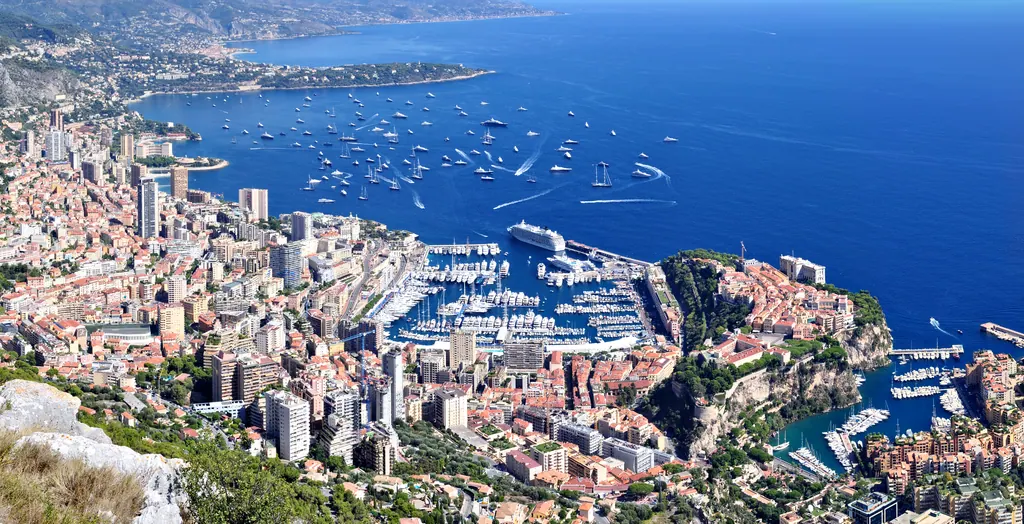
Monaco is smaller than Central Park and is one of the most densely populated countries on earth, with apartment towers stacked up the hillside above the harbor. The Grimaldi family has ruled here since the 13th century, and the current head of state is Prince Albert II.
The highlights are close together. On the Rock, the old town of Monaco-Ville, you find the Prince's Palace, the cathedral where Princess Grace is buried, and the Oceanographic Museum, built into the cliff above the sea. Across the harbor is Monte Carlo, with its famous casino and the streets that become the Formula 1 circuit each year in late spring. Monaco is an easy day trip by regional train from Nice, roughly 20 to 25 minutes along the coast.
3. San Marino
San Marino calls itself the oldest surviving republic in the world, tracing its founding to a community established by Saint Marinus in the year 301. The country is built around Mount Titano, and its old town and the three towers on the ridge are a UNESCO World Heritage Site, inscribed in 2008.
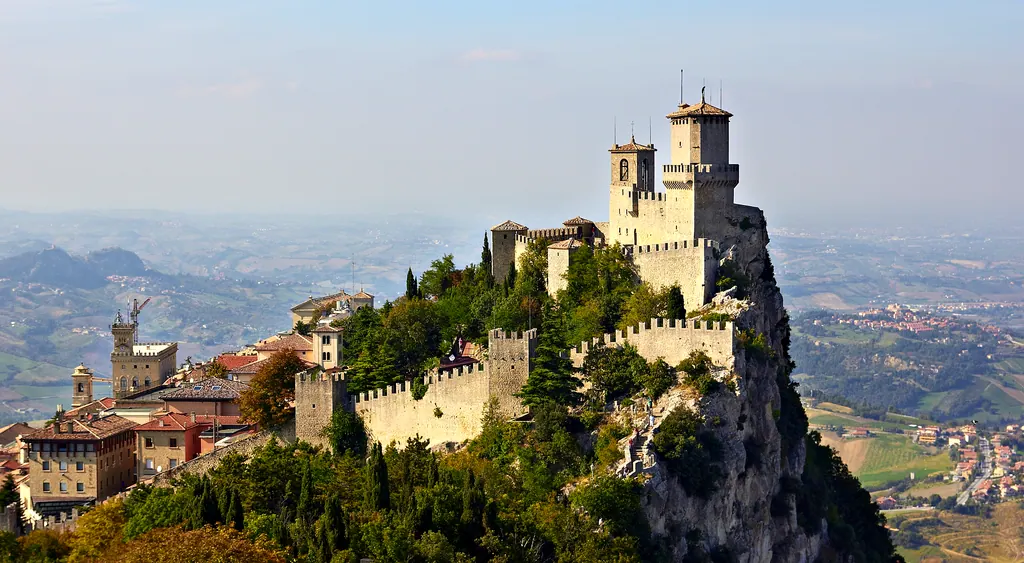
The walk along the ridge between the first two towers, Guaita and Cesta, is the highlight, with views across the hills toward the Adriatic coast. The old town is steep and compact, full of small museums and shops. Most visitors arrive by bus from Rimini on the Italian coast, a trip of about an hour. You can also get a souvenir stamp in your passport at the tourist office for a small fee.
4. Liechtenstein
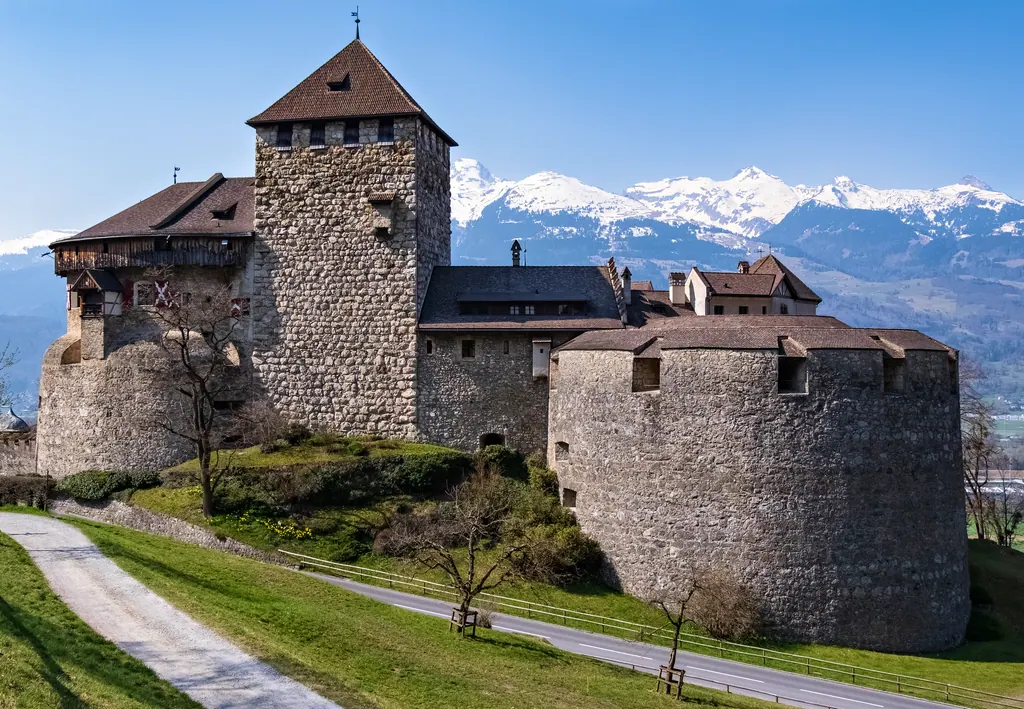
Liechtenstein is about the size of Washington, D.C., and squeezed between Switzerland and Austria along the Rhine. It is one of only two doubly landlocked countries in the world (the other is Uzbekistan), meaning that it is surrounded only by other landlocked countries. Created in 1719, it is the last surviving principality of the Holy Roman Empire.
The capital, Vaduz, is small enough to see in a few hours: the Kunstmuseum Liechtenstein for modern art, the national museum, and above it all Vaduz Castle, home of the princely family. The castle itself is not open to visitors, but the walk up gives fine views of the Rhine valley. Liechtenstein has no airport and no border controls with Switzerland. Most travelers arrive by train to Sargans or Buchs in Switzerland or Feldkirch in Austria and continue by bus.
5. Malta
Malta is a different kind of small country: an island nation of more than half a million people and the smallest member of the European Union. Its capital, Valletta, was built by the Knights of St. John after the Great Siege of 1565, and the whole city has been a UNESCO World Heritage Site since 1980.
Malta is the only country on this list where you need more than a day. Beyond Valletta there are the walled hilltop town of Mdina, the prehistoric temples that are among the oldest freestanding structures in the world, the quieter island of Gozo, and clear water for swimming and diving from late spring to fall. There are no nonstop flights from the U.S., but frequent connections through European hubs.
6. Andorra
High in the Pyrenees between France and Spain, Andorra has two heads of state: the Bishop of Urgell in Spain and the President of France, who serve together as co-princes. Its capital, Andorra la Vella, is the highest capital city in Europe, at a little over 3,300 feet (about 1,000 meters).
Visitors come for skiing in winter, hiking in summer and tax-free shopping all year. Andorra has no airport and no train station, so you arrive by road, usually by bus from Barcelona in about three hours or from Toulouse in France.
What About Passports and Borders?
As a U.S. citizen you can visit all six without a visa for a short trip, but the rules are not identical:
- Malta and Liechtenstein are members of the Schengen area, so time there counts toward the usual 90 days in any 180-day period.
- Monaco, San Marino and Vatican City are not formal Schengen members but have open borders with France or Italy, so in practice you arrive without passport checks.
- Andorra is outside both the EU and the Schengen area, and there are customs posts at the borders with France and Spain. Bring your passport, and be aware of duty-free limits when you leave with shopping.
As of November 11, 2026, the EU's ETIAS travel authorization is still not in operation, and the EU says it will announce the start date several months ahead. Our guide to tipping in Europe covers the other practical question most visitors have.
How to Collect Them All
Five of the six fit neatly into classic European itineraries: the Vatican with Rome, Monaco with the French Riviera, San Marino with Bologna or the Adriatic coast, Liechtenstein with Zurich or the Swiss Alps, and Andorra with Barcelona. Malta deserves a trip of its own, or a few days on the way to or from Sicily.
If you are the kind of traveler who keeps a list of countries visited, the microstates are the easiest additions you will ever make. Just do not rush them. Stay for sunset on San Marino's ridge or an evening by the harbor in Monaco, and these tiny countries stop feeling like trivia and start feeling like places. For more lists like this one, browse our Top Lists, including the countries that drive on the left.
Frequently asked questions
What is the smallest country in Europe?
Vatican City, which covers about 0.19 square miles (0.49 square kilometers) inside Rome. It is also the smallest country in the world.
What are the six European microstates?
Vatican City, Monaco, San Marino, Liechtenstein, Malta and Andorra, in order of size from smallest to largest.
Do you need a passport to visit Monaco or San Marino?
There are no border checks between France and Monaco or between Italy and San Marino, but you should carry your passport as ID, as you would anywhere in Europe.
Which microstate is not in the Schengen area?
Andorra is outside both the EU and the Schengen area, and there are customs posts at its borders with France and Spain.