In summer, a mountain railway is a pleasant way to see the Alps. In winter it becomes something else. The roads over the high passes close, the snow piles up to the windows, and the train is suddenly the only thing moving through a white, silent landscape. You get the views of a mountaineer with a cup of coffee in your hand.
Europe has some of the most spectacular winter rail journeys in the world, and most of them are ordinary scheduled trains that run every day of the season. Here are six worth planning a trip around, from the Swiss Alps to the Arctic Circle, with what to know before you book.
1. Bernina Express, Switzerland and Italy
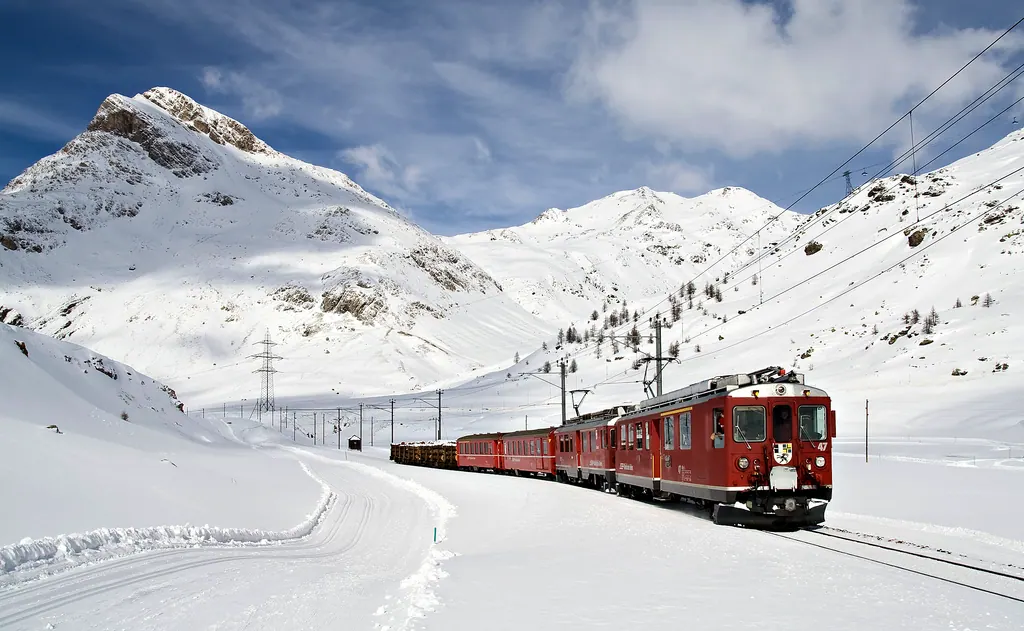
If you only ride one train in the snow, make it this one. The Bernina Express runs from Chur in eastern Switzerland over the Bernina Pass to Tirano in Italy in about four hours, crossing 196 bridges and passing through 55 tunnels. At Ospizio Bernina, 7,392 feet (2,253 m) above sea level, it reaches the highest point of any railway crossing the Alps, and in winter the frozen Lago Bianco beside the station is often buried under snow.
The line is a UNESCO World Heritage Site, together with the Albula line, since 2008, and the engineering is part of the show. The train climbs steep grades without a cog rail, loops around the circular Brusio viaduct and drops from glaciers to palm trees in a single morning. In winter 2026/27, there is one Bernina Express a day in each direction between Chur and Tirano, and seat reservations are mandatory.
Best seat: The right side heading south toward Tirano for the Morteratsch glacier and Lago Bianco.
2. Glacier Express, Switzerland
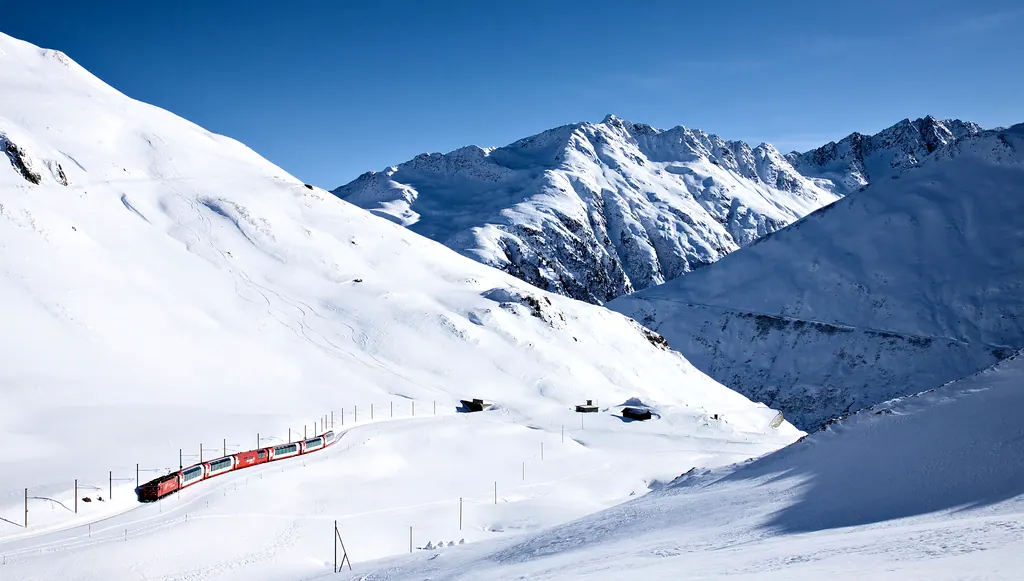
The Glacier Express calls itself the slowest express train in the world, and it is proud of it. The trip from Zermatt to St. Moritz takes about eight hours over 291 bridges and through 91 tunnels, with the Oberalp Pass at 6,670 feet (2,033 m) as its high point. In winter, that stretch runs between snow walls with almost nothing in sight but white mountainsides and a few buried huts.
The panoramic cars have windows that curve up into the roof, which matters on a route where the views are as much above you as beside you. The train takes a seasonal break each fall. For 2026, the Glacier Express does not run from October 11 to December 4 and resumes on December 5, 2026, so plan a December trip for the second week or later. Seat reservations are mandatory and open about three months ahead for first and second class.
3. Bergen Line, Norway
The railway between Oslo and Bergen is one of the great mountain lines in northern Europe. It takes about seven hours and crosses Hardangervidda, Europe's largest mountain plateau, above the tree line. In winter, the plateau is a sheet of snow and the train passes cross-country skiers and snowkiters at stations that have no road access.
Finse, at 4,009 feet (1,222 m), is the highest station on the line and a stop worth breaking the trip for. There is no road to Finse at all, so arriving by train at a mountain hotel at the edge of the Hardangerjøkulen glacier feels like a genuine expedition. Norway's operator Vy runs the route several times a day, so you can choose a morning departure and ride it in daylight, which is short in December.
4. Flåm Railway, Norway
The Flåm Railway connects with the Bergen Line at Myrdal and drops about 20 km (12 miles) down to the village of Flåm at the end of the Aurlandsfjord. On most of the route the gradient is 5.5 percent, among the steepest for an ordinary railway anywhere, and the train descends from 2,841 feet (866 m) at Myrdal almost to sea level in roughly an hour. Frozen waterfalls hang from the cliffs, and the valley floor is often deep in snow while the fjord at the bottom stays dark and open.
The railway runs all year, with four departures each way per day in the winter season from November to March, according to local operators. Combining the Bergen Line and the Flåm Railway with a night in Flåm is one of the easiest winter trips in Norway without a car.
5. Stockholm to Narvik, Sweden and Norway
This is the journey for travelers who want to go north, really north. SJ's night train leaves Stockholm in the evening and arrives in Narvik on the Norwegian coast around midday the next day, a trip of roughly 18 and a half hours. For a while, passengers had to leave the sleeper at Boden early in the morning and continue in a seated train, but under a new contract with the Swedish Transport Administration, SJ runs the night train all the way to Narvik every day from the timetable change on December 13, 2026. By morning you are above the Arctic Circle, rolling through Swedish Lapland past frozen lakes and birch forest under a sky that barely gets light in midwinter.
The last part, the Ofoten Line from the Swedish border down to Narvik, clings to steep mountainsides above the Ofotfjord and is one of the most dramatic stretches of rail in Scandinavia. The train stops at Abisko, a national park known as one of the best places in Sweden to see the northern lights, so many travelers break the trip there for a few nights. See our guide to where to see the northern lights for more on Abisko and the season.
6. West Highland Line, Scotland
Not every great winter train needs to cross the Alps. The West Highland Line runs from Glasgow to Fort William and Mallaig, through the wild, empty Rannoch Moor and over the curving Glenfinnan Viaduct, which many travelers know from the Harry Potter films. Corrour, on the moor, is often cited as the highest mainline station in Britain at about 1,340 feet (408 m), with no public road access.
The famous Jacobite steam train only runs in the warmer months, but the regular ScotRail trains follow the same tracks all year for a fraction of the price. In winter, a dusting of snow on the moor and low light over Loch Shiel make the trip as dramatic as any in Europe. Combine it with Hogmanay in Scotland if you are traveling around New Year; our guide to Hogmanay explains the traditions.
How to Plan a Winter Rail Trip in Europe
- Book reservations, not just tickets. The Bernina Express and Glacier Express require seat reservations on top of a ticket or rail pass, and both sell out on popular dates.
- Ride in daylight. In December, the sun sets around 4:30 p.m. in the Alps and much earlier in northern Norway and Sweden. Pick morning departures for scenic stretches.
- Check passes before you buy. The Swiss Travel Pass and Eurail Pass cover the fares on the Swiss routes, but the reservation fee is extra.
- Expect weather. Heavy snow and avalanches occasionally close mountain lines for a few hours. Build a buffer day into any itinerary with a flight at the end.
- Dress for the platform, not the train. The carriages are warm, but changing trains at Myrdal, Finse or Abisko means standing in real winter.
If train travel is your favorite way to see a country, there is more in our train travel section, including the most scenic train rides in the U.S..
Which One First?
For a first winter rail trip, start in Switzerland. The Bernina Express gives you the most spectacular scenery in the shortest time, and you can add the Glacier Express for a full day on rails. If you want snow and solitude rather than Alpine drama, take the Bergen Line to Finse and Flåm. And if the goal is the Arctic, the night train to Narvik with a stop in Abisko is one of the great slow journeys left in Europe.
Frequently asked questions
Does the Glacier Express run in winter?
Yes. It pauses each fall, in 2026 from October 11 to December 4, and runs again from December 5, 2026, through the winter season.
Is the Bernina Express worth it in winter?
Many travelers think winter is its best season, with deep snow at the Bernina Pass and frozen Lago Bianco. There is one Bernina Express a day each way in winter 2026/27, so reserve early.
Do I need a reservation with a Eurail or Swiss Travel Pass?
Yes, on the Bernina Express and Glacier Express. The pass covers the fare, but the mandatory seat reservation costs extra.
Which winter train is best for the northern lights?
The night train from Stockholm to Narvik stops at Abisko in Swedish Lapland, one of the best bases in Scandinavia for the northern lights.