Picture a lunch break where you ski across a national border, order a plate of pasta at a mountain hut, and ski back to a different country before the lifts close. Or a town where the main street is a car-free medieval lane, and the train from the airport drops you a short walk from the gondola. That is ordinary in the Alps.
For American skiers, Europe can feel like a big leap: longer flights, unfamiliar trail maps, different etiquette. But the reward is huge ski areas, real villages, and mountain food that has little in common with a cafeteria burger. We picked seven resorts that each give you a different reason to make the trip, from famous names to one that costs a fraction of the others.
Zermatt, Switzerland
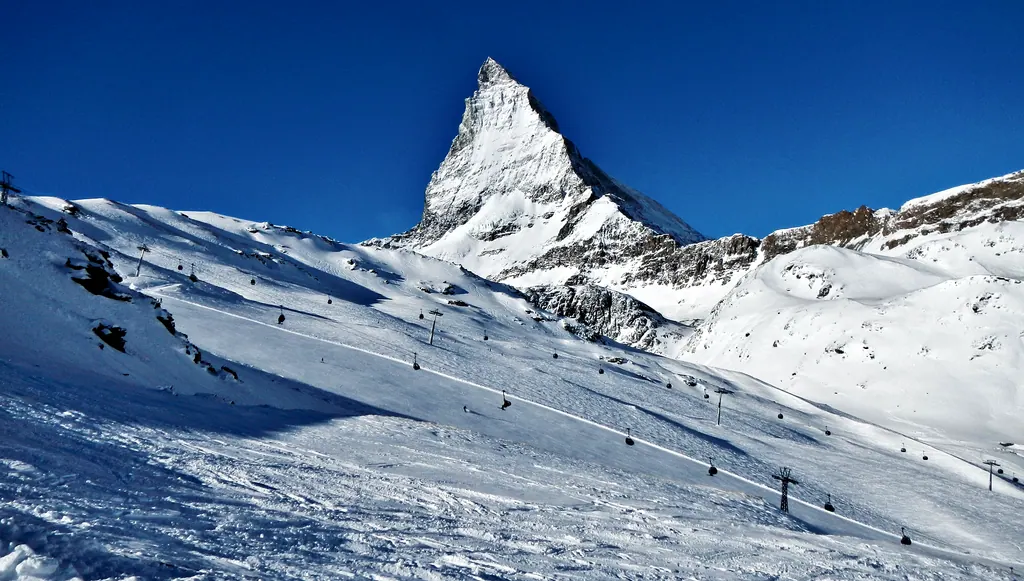
Zermatt is the one people picture before they have ever been. The village is car-free, so you arrive by train from Täsch or farther down the valley, and electric taxis do the rest. Above it all stands the Matterhorn, 14,692 feet (4,478 m) high, visible from many of the runs.
The ski area, called Matterhorn Ski Paradise, links Zermatt with Cervinia and Valtournenche in Italy and has around 224 miles (360 km) of pistes and 52 lifts. That is what makes the cross-border lunch possible. The highest lift station, Matterhorn Glacier Paradise, sits at about 12,740 feet (3,883 m), which means reliable snow high up and the option of glacier skiing even outside the main season.
Best for: scenery, long cruising runs, and a village that feels like a destination in itself. Keep in mind: Zermatt is expensive, even by Swiss standards.
St. Anton am Arlberg, Austria
St. Anton has a strong claim to being the place where modern skiing began. Hannes Schneider started his ski school here in 1921, and the Arlberg technique taught in the village shaped how much of the world learned to ski.
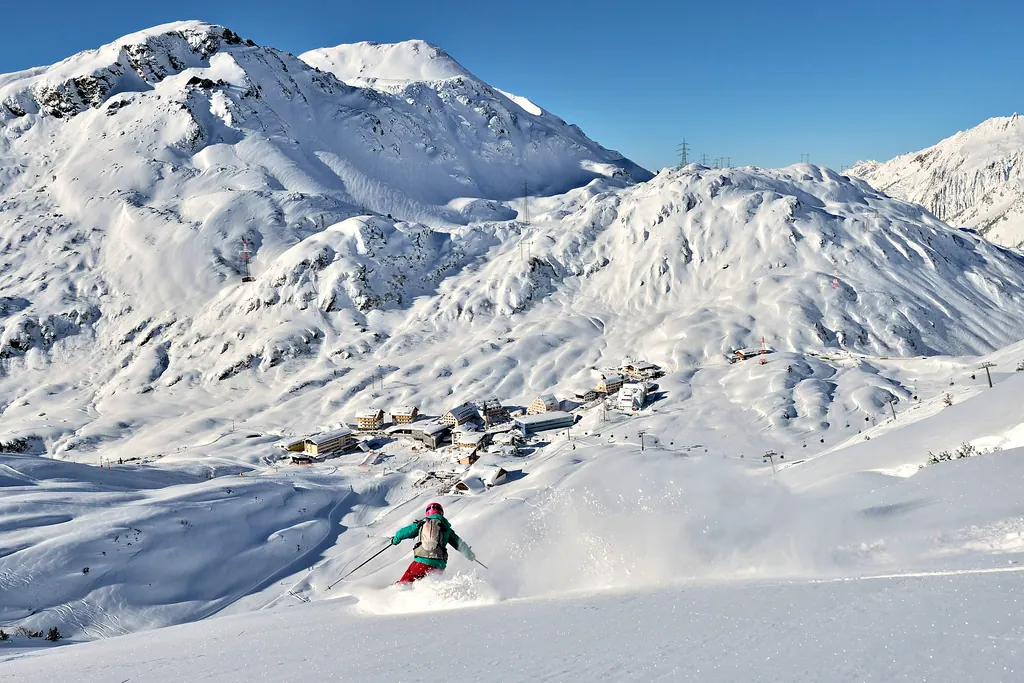
Today St. Anton is part of Ski Arlberg, Austria's largest connected ski area, with about 186 miles (300 km) of marked runs and 85 lifts linking it with St. Christoph, Stuben, Lech, Zürs and Warth-Schröcken. The terrain is known for steep, demanding runs and good off-piste with a guide, and the village is famous for some of the liveliest après-ski in the Alps. St. Anton also has its own station on the main railway line between Zurich and Innsbruck, so you can arrive without a car.
Best for: strong skiers and people who like to party after the lifts close. Keep in mind: beginners have fewer easy runs here than in some other resorts.
Chamonix, France
Chamonix hosted the first Winter Olympics in 1924, and it still feels more like a mountaineering town than a purpose-built resort. Mont Blanc, the highest mountain in Western Europe, rises directly above the valley.
Chamonix is not one ski area but several, including Brévent-Flégère, Les Grands Montets and Balme, connected by buses along the valley floor. The headline experience is the Vallée Blanche, a roughly 12-mile (20 km) off-piste descent across glaciers that starts at the top of the Aiguille du Midi cable car, at 12,605 feet (3,842 m). It is unmarked and unpatrolled glacier terrain, so go with a certified mountain guide.
Best for: advanced skiers, big-mountain terrain and anyone who loves the idea of alpine history. Keep in mind: the separate ski areas mean more time on buses, and the easier terrain is limited.
Les 3 Vallées, France
If size is the measure, Les 3 Vallées wins. It bills itself as the world's largest connected ski area, with about 373 miles (600 km) of pistes and 169 lifts spread over resorts including Courchevel, Méribel and Val Thorens. You can ski for a week without repeating a run.
Each village has its own personality. Courchevel is the glamorous one, with luxury hotels and an altiport for small planes. Méribel, in the middle, is built in a chalet style and is popular with families. Val Thorens, at about 7,546 feet (2,300 m), is the highest ski resort in Europe, with excellent snow and a lot of terrain right outside the door.
Best for: mileage and variety, especially for intermediate skiers. Keep in mind: the purpose-built parts of some villages lack the old-town charm of Zermatt or St. Anton.
The Dolomites, Italy
The Dolomites look different from the rest of the Alps. Pale limestone towers rise straight out of the snowfields, and at sunset the rock often glows pink. The mountains are a UNESCO World Heritage Site, and the skiing is organized under one lift pass, Dolomiti Superski, which covers about 746 miles (1,200 km) of slopes and around 450 lifts across 12 ski areas.
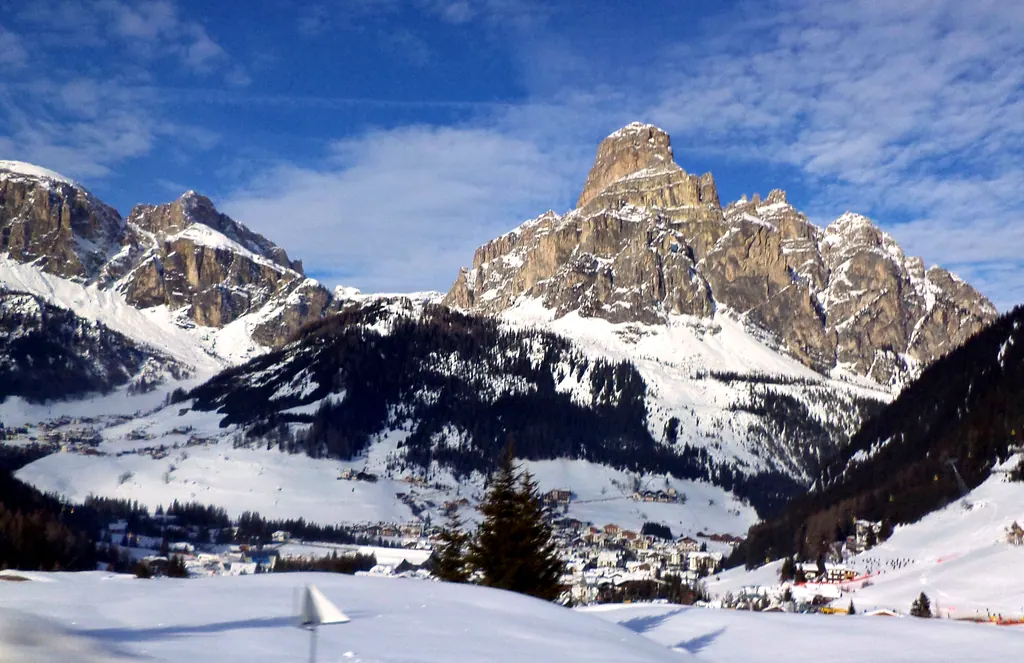
The classic tour is the Sella Ronda, a full-day circuit around the Sella massif that links Val Gardena, Alta Badia, Arabba and Val di Fassa, and can be skied clockwise or counterclockwise. Cortina d'Ampezzo, which co-hosted the 2026 Winter Olympics with Milan, is part of the same pass. The other draw is the food: mountain huts, called rifugi, serve dumplings, polenta, pasta and strudel at a level that surprises most first-time visitors.
Best for: scenery, long scenic tours and long lunches. Keep in mind: much of the skiing is on groomed runs, and expert off-piste terrain is more limited than in Chamonix.
Kitzbühel, Austria
Kitzbühel combines a medieval town center with one of skiing's most famous race courses. The Streif, on the Hahnenkamm mountain, hosts a World Cup downhill each January that draws huge crowds. In 2027, the Hahnenkamm Races run from January 18 to 24, with the downhill on Saturday, January 23.
The KitzSki area has about 145 miles (233 km) of slopes and 58 lifts. For most visitors it is an intermediate's playground, with wide, rolling runs and plenty of mountain restaurants. The town itself, with its pastel facades and shops, is a pleasure to walk around in the evening.
Best for: a stylish town base and well-groomed intermediate skiing. Keep in mind: the town sits at only about 2,500 feet (762 m), so the lower slopes depend on snowmaking early and late in the season.
Bansko, Bulgaria
Bansko is the wild card on this list, and the one that changes the budget. The resort sits at the foot of the Pirin Mountains, where Pirin National Park is a UNESCO World Heritage Site, and it has more than 47 miles (75 km) of groomed pistes. A gondola about 3.9 miles (6.2 km) long runs from the edge of town up to the ski area.
The prices are the reason most people come. In the 2025-26 high season, an adult day pass cost about 59 euros (about $65 in 2026), including the gondola, far below what you pay in the big Alpine resorts. Bulgaria adopted the euro on January 1, 2026, which makes costs easy to compare. The old town has stone houses and traditional taverns called mehanas. Our guide to whether Bulgaria is cheap covers what a trip costs beyond the slopes.
Best for: budget-conscious skiers and groups who want a full week for less. Keep in mind: the ski area is much smaller than the Alpine giants, and the gondola can have long lines in the morning.
Getting There and Using Your Pass
Most of these resorts are within a few hours of a major airport. Geneva works for Chamonix and Les 3 Vallées, Zurich for Zermatt and St. Anton, Innsbruck, Salzburg and Munich for Kitzbühel, Venice, Verona and Innsbruck for the Dolomites, and Sofia for Bansko. In Switzerland and Austria, trains often take you all or most of the way to the village.
If you already own a U.S. multi-resort pass, check its European partners before you buy lift tickets. For the 2026-27 season, the Ikon Pass includes days at Zermatt, Chamonix, Kitzbühel and Dolomiti Superski, and the Epic Pass includes Andermatt and Crans-Montana in Switzerland, plus limited days at Ski Arlberg. Day limits and conditions apply, so read the pass details.
Which One Should You Choose?
| If you want | Go to |
|---|---|
| The postcard view and a car-free village | Zermatt |
| Steep runs and serious après-ski | St. Anton |
| Big-mountain terrain with a guide | Chamonix |
| The most miles of runs | Les 3 Vallées |
| Scenery and the best mountain food | The Dolomites |
| A charming town and easy cruising | Kitzbühel |
| A ski week on a tight budget | Bansko |
One last thing before you book: on-the-mountain rescue in much of Europe is billed to the skier, and U.S. health insurance rarely follows you abroad. Our guide to ski travel insurance explains what to check. For more trips built around moving outdoors, see our active holidays page.
Frequently asked questions
Which country has the best skiing in Europe?
Switzerland, Austria, France and Italy all have world-class resorts. France has the largest linked ski areas, Austria is known for après-ski and village charm, Switzerland for scenery, and Italy for the Dolomites and mountain food.
What is the largest ski area in Europe?
Les 3 Vallées in France bills itself as the world's largest connected ski area, with about 373 miles (600 km) of pistes. Dolomiti Superski covers more runs on one pass, but across separate areas.
Can I use my Ikon or Epic Pass in Europe?
For 2026-27, the Ikon Pass includes days at Zermatt, Chamonix, Kitzbühel and Dolomiti Superski, and the Epic Pass includes Andermatt and Crans-Montana in Switzerland. Day limits apply.
What is the cheapest ski resort in Europe?
Eastern European resorts such as Bansko in Bulgaria are among the cheapest, with an adult day pass of about 59 euros in the 2025-26 high season.