Walk down almost any side street in Tainan and you will pass a temple before you reach the end of the block. Some are grand halls with dragons twisting along the ridgelines, others are a single room with a plastic stool, a fan and an altar crowded with gods. Smoke drifts out of the doorways, scooters park in front, and someone is usually inside asking for advice about an exam, a job or a marriage.
That everyday closeness is what makes culture in Taiwan so easy to reach. The island packs four centuries of layered history into a small space: Indigenous peoples who were here first, Dutch and Spanish traders, Qing dynasty settlers from Fujian and Guangdong, 50 years of Japanese rule and the arrival of the Nationalist government in 1949. Below we look at where you see each of those layers, which festivals are worth planning a trip around, and how to behave when you step through a temple door. For what to eat along the way, see our guide to food in Taiwan.
Why do temples matter so much in Taiwan?
Taiwanese folk religion blends Buddhism, Taoism, Confucian ideas and local deities, so one building can hold Guanyin, the goddess of mercy, alongside Mazu, the sea goddess who protected settlers crossing the Taiwan Strait. Temples are also community centers, where neighbors meet, puppet shows are staged for the gods' birthdays and processions start.
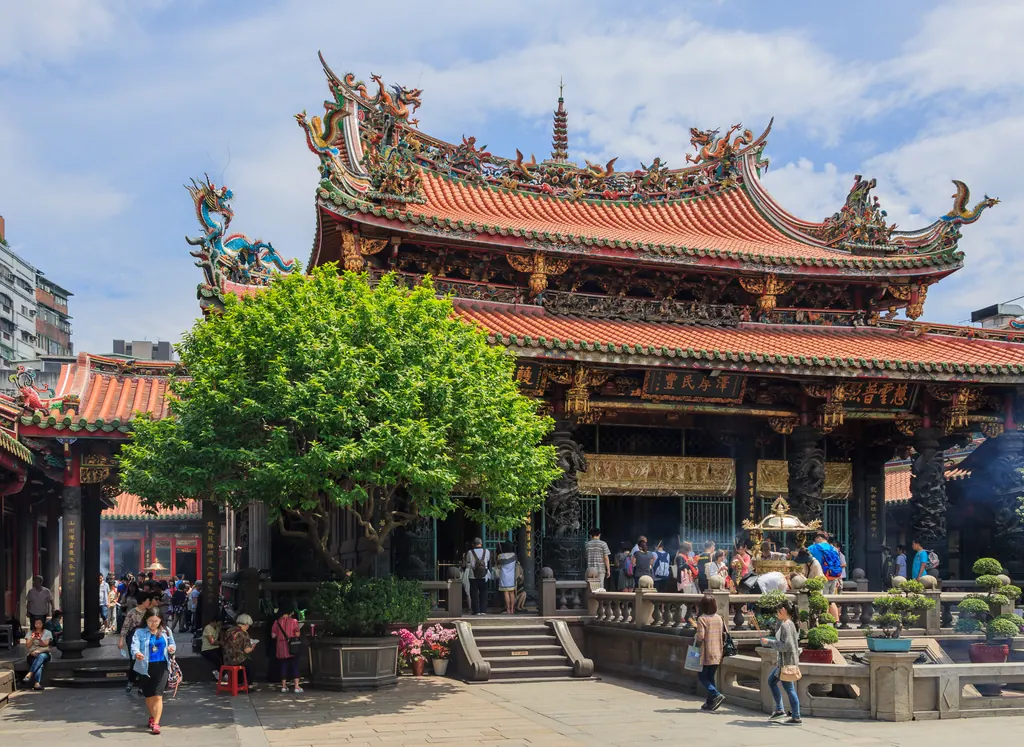
Mengjia Longshan Temple in Taipei's Wanhua district is the place most visitors start. Settlers from Fujian founded it in 1738, and it has been rebuilt several times after earthquakes, fires and a bombing raid in 1945, so most of what you see dates from the 20th century. The carved dragon columns and the steady flow of worshippers make it a good introduction, and entry is free. Come early morning or evening, when chanting fills the main hall.
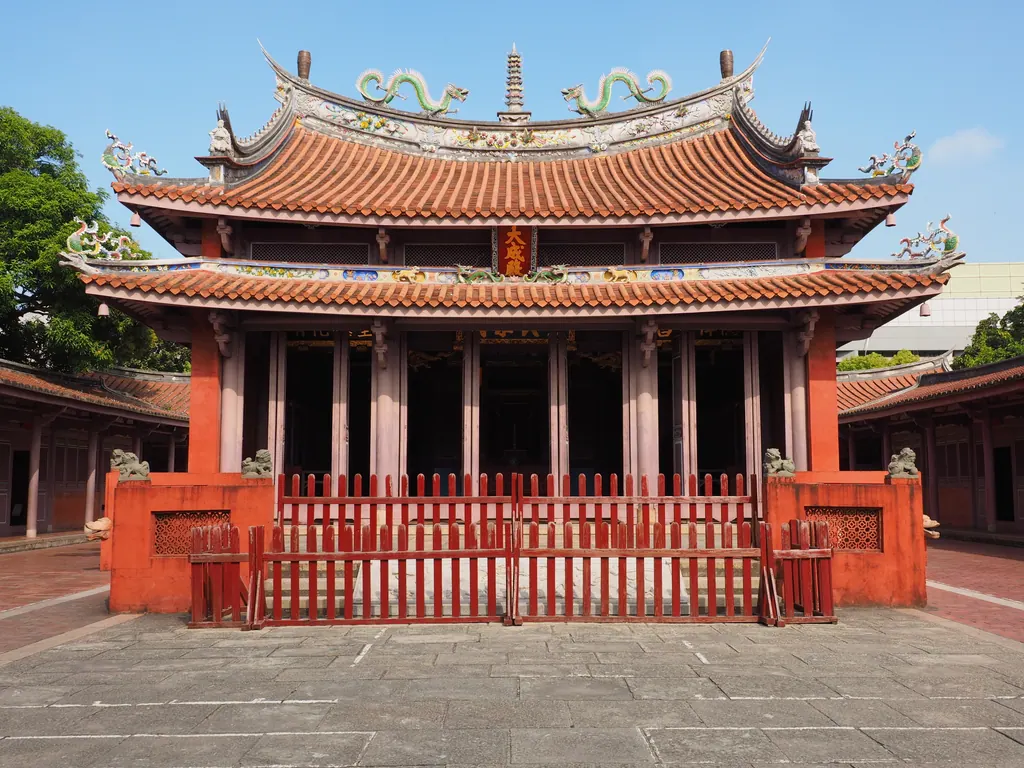
Tainan, the island's capital for more than two centuries, has the densest collection of old temples. The Tainan Confucius Temple was completed in 1665 and is known as the first school in Taiwan. Its red walls and quiet courtyards are calmer than the busy folk temples, and in recent years the grounds have been free while the inner Dacheng Hall charged around NT$40 (about $1.25). Within walking distance you find the Grand Mazu Temple, the Official God of War Temple and dozens of smaller shrines, enough for a full day on foot.
Further north, the old port town of Lukang in Changhua County has its own Longshan Temple, admired for its woodwork and the carved octagonal ceiling above the stage, and a busy Tianhou Temple dedicated to Mazu. Lukang's narrow lanes and old merchant houses make it an easy day trip from Taichung.
What is the Mazu pilgrimage?
Each spring, around the third month of the lunar calendar, Taiwan holds one of the largest religious processions in Asia. The Dajia Mazu pilgrimage leaves Jenn Lann Temple in Taichung and carries a statue of the goddess on a sedan chair for nine days and eight nights, covering around 340 km (about 210 miles) through Taichung, Changhua, Yunlin and Chiayi and stopping at more than 100 temples on the way. Hundreds of thousands of people join at least part of it, many walking for days.
You do not need to walk the whole route. An afternoon in a town along the way gives you firecrackers, drum troupes and locals kneeling in the road so the sedan chair can pass over them for a blessing. Expect noise, smoke and crowds. A second, looser pilgrimage leaves Baishatun in Miaoli County, famous because the route is not fixed in advance: the goddess decides where to go.
The exact start date is chosen each year by casting moon blocks at the temple, so check Jenn Lann Temple's announcements in early spring.
Which museums are worth your time?
The National Palace Museum in Taipei holds one of the world's great collections of Chinese art, much of it brought from the mainland in 1948 and 1949. The famous pieces are small: a piece of jadeite carved into a cabbage with insects on its leaves, and a stone that looks like a slab of braised pork. Displays rotate, so check what is on before you go. Adult admission was around NT$350 (about $11) in 2026, and the museum is normally closed on Mondays. Arrive at opening time or late in the afternoon to avoid the tour groups.
Across the road, the small Shung Ye Museum of Formosan Aborigines is a good introduction to Taiwan's Indigenous peoples, and in the city center the National Taiwan Museum sits in a domed Japanese-era building beside 228 Peace Memorial Park.
Elsewhere, these museums repay a detour:
- National Museum of Taiwan History (Tainan): the island's story from prehistory to democracy, told with Taiwan, not China, at the center.
- Chimei Museum (Tainan): a private collection of Western art, musical instruments and arms in a palace-like building.
- National Taiwan Museum of Fine Arts (Taichung): modern and contemporary Taiwanese art, with free entry and a large sculpture park.
- National Museum of Prehistory (Taitung): finds from the Peinan site, a large prehistoric village and burial site known for its slate coffins.
- Lanyang Museum (Yilan): a striking building tilted like the coastal rocks, about the county's mountains, plains and sea.
Where can you see Taiwan's Japanese-era heritage?
Japan ruled Taiwan from 1895 to 1945, and the period left railway stations, government buildings and wooden houses that many Taiwanese now restore with care. In Taipei, the Presidential Office Building, completed in 1919, still dominates the government district, and guided tours are offered on some weekdays. The Hayashi Department Store in Tainan opened in 1932 as one of the island's first department stores and once again sells local design and snacks, with an elevator and a rooftop shrine you can visit.
In Chiayi, Hinoki Village has restored the wooden dormitories of the forestry workers who logged Alishan's cypress forests, and the old gold mining towns of Jiufen and Jinguashi keep teahouses and steep lanes from the mining years. Jiufen is very crowded on weekends, so come on a weekday.
How can you meet Taiwan's Indigenous cultures?
Taiwan officially recognizes 16 Indigenous peoples, around 2.5 percent of the population. Their languages are Austronesian, related to those of the Philippines, Indonesia and the Pacific, and many researchers see Taiwan as the starting point of that migration.
The east coast is the heart of Indigenous Taiwan. In Hualien and Taitung, the Amis, the largest group, live alongside the Puyuma, Bunun, Rukai and others between the mountains and the Pacific. Taitung has a growing Indigenous arts scene, with music evenings, woodcarving and weaving workshops and small galleries.
At Sun Moon Lake, the Thao people, one of the smallest recognized groups, live in the lakeside village of Ita Thao. It is commercial in places, but it shows how a very small community is working to keep its language alive.
The best time to visit is during the harvest festivals of July, August and September. The Amis call theirs Ilisin, and villages along the east coast hold several days of singing, circle dances and feasting to give thanks for the harvest. Some days are for the community only. Ask before you photograph people and do not step into the dance circle unless invited. Hualien and Taitung also hold larger joint harvest festivals aimed at the public.
What about Hakka culture?
The Hakka, who arrived from Guangdong and Fujian in the 18th and 19th centuries, make up close to a fifth of the population and have their own language, food and festivals. In Meinong, north of Kaohsiung, workshops still make hand-painted oil-paper umbrellas and the countryside is full of tobacco barns and rice fields. Beipu in Hsinchu County has a compact old town with temples, historic houses and shops selling lei cha, a ground tea drink.
In April and May, the Hakka Tung Blossom Festival draws visitors to the hills of Miaoli, Hsinchu and Taoyuan, where white tung tree blossoms fall like snow on the forest paths.
Where is the street art and creative scene?
In Taipei, Huashan 1914 Creative Park occupies a former winery built in 1914, with exhibition halls, small shops, cafes and concerts in the old brick buildings. The nearby Songshan Cultural and Creative Park, once a tobacco factory, hosts design shows and has a quiet pond in its garden. Our shopping guide to Taiwan covers the design stores in both.
In Kaohsiung, Pier-2 Art Center took over harbor warehouses from the 1970s and opened in the early 2000s. Today it stretches along the waterfront with outdoor sculptures, murals, galleries and a bike path. The huge Weiwuying arts center, opened in 2018, is worth seeing for its wave-shaped roof alone.
Taichung's art scene centers on the fine arts museum mentioned above and the small galleries, design shops and cafes along the Calligraphy Greenway, a park strip that runs past the museum.
Which festivals are worth planning a trip around?
Taiwan's traditional festivals follow the lunar calendar, so the dates change every year. The table gives the timing and the expected 2027 dates where they are fixed.
| Festival | When | Where to see it |
|---|---|---|
| Lunar New Year | February 6, 2027 (holiday from early February) | Temples nationwide, especially at midnight on New Year's Eve |
| Lantern Festival | 15th day of the first lunar month (February 20, 2027) | Pingxi sky lanterns, Yanshui fireworks, the national Taiwan Lantern Festival |
| Mazu pilgrimages | Around the third lunar month (March to April) | Dajia in Taichung, Baishatun in Miaoli |
| Dragon Boat Festival | June 9, 2027 | Races on rivers and lakes, including Lukang and Taipei |
| Indigenous harvest festivals | July to September | Villages in Hualien and Taitung |
| Yilan Children's Folklore and Folkgame Festival | July to mid-August | Dongshan River Water Park, Yilan |
| Ghost Month | Seventh lunar month (usually August) | Keelung, Toucheng in Yilan |
Lunar New Year is a family holiday. Many shops close for several days, trains fill up and hotel prices rise: good for packed temples, poor for a first trip.
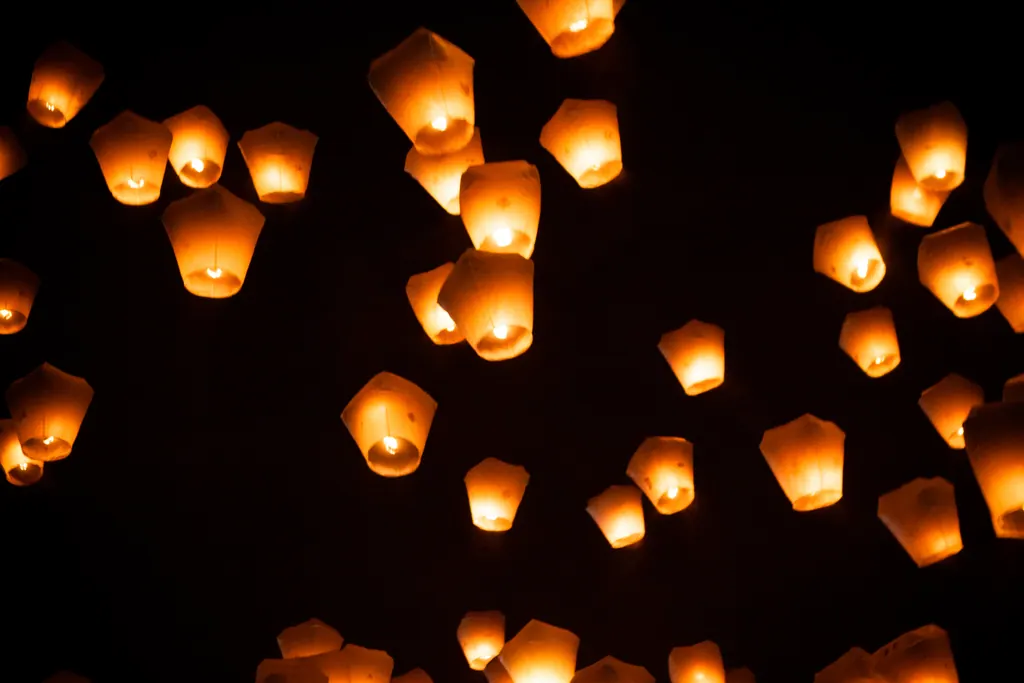
The Lantern Festival two weeks later is the high point of the winter. In Pingxi, in the hills east of Taipei, thousands of paper sky lanterns are released into the night sky in organized mass launches. In Yanshui, in Tainan, the beehive fireworks festival is the opposite of gentle: towers of rockets are fired straight into the crowd. Locals see the stings as a cleansing ritual. If you go, wear a full-face motorcycle helmet, thick cotton clothing that covers your skin, gloves and a towel around your neck, because the rockets hurt and can burn. A different city hosts the official Taiwan Lantern Festival each year, with large light installations.
The Dragon Boat Festival on the fifth day of the fifth lunar month brings boat races, sticky rice dumplings called zongzi and the tradition of balancing an egg upright at noon.
Ghost Month is the seventh lunar month, when the gates of the underworld are believed to open. Families put food offerings outside shops and homes, and some locals avoid swimming or moving house. The Keelung Mid-Summer Ghost Festival is one of the most elaborate, with a parade and paper lanterns floated on the sea to guide lost souls. At the end of the month, Toucheng in Yilan holds the Qiang Gu (grappling the old) competition, in which teams climb greased poles to grab offerings at the top.
In summer, the Yilan International Children's Folklore and Folkgame Festival fills Dongshan River Water Park with folk dance groups from around the world, water play and craft stalls. In 2026 it ran from July 4 to August 16. It is one of Taiwan's best festivals for families, and Yilan's leisure farms, where you can pick fruit or plant rice, make an easy add-on.
How should you behave in a temple?
Temples are open to everyone, and nobody expects foreign visitors to know every rule. A few habits show respect:
- Enter through the right door and leave through the left (as you face the temple). The center door is traditionally for the gods.
- Step over the threshold, not on it.
- Dress modestly enough to feel comfortable around worshippers. There is no strict dress code in most temples, but very short shorts and beachwear stand out.
- Photography is usually fine, but do not use a flash, do not photograph people at prayer at close range, and watch for signs that forbid photos of the altar.
- Do not point at the statues of the gods or turn your back on the main altar at close range.
- Join in if you want to. You can light incense, usually offered at a counter, and move from burner to burner in the order shown. Try the red crescent-shaped moon blocks, called jiaobei: you ask a yes or no question and throw them, and one flat side up and one round side up means yes.
- Leave a small donation in the box if you have taken incense or spent time inside. There is no fixed amount.
Planning a culture trip
If you only have a week, base yourself in Taipei for museums and creative parks, then take the high-speed train to Tainan for temples and history. Add the east coast if you have more time, ideally in summer when the harvest festivals are on. Our guide to getting around Taiwan explains the trains and buses that link these places, and you find more ideas on the Taiwan destination page.
If you can pick only one festival, the Lantern Festival is the most spectacular (book early), the Mazu pilgrimage the most intense and the summer harvest festivals the most personal. For a different take on festival culture elsewhere in Asia, read about culture and festivals in the Philippines.
Frequently asked questions
Is it okay for tourists to take photos inside Taiwanese temples?
Usually yes. Skip the flash, avoid close-up shots of people praying, and look for signs, since some temples ask visitors not to photograph the main altar.
How much does the National Palace Museum in Taipei cost?
Adult admission was around NT$350 (about $11) in 2026, with reduced tickets for students and seniors. The museum is normally closed on Mondays, so check the official website before you go.
Can tourists release sky lanterns in Pingxi outside the festival?
Yes. Shops along Shifen Old Street sell lanterns all year, and you can write wishes on them and launch them from the railway tracks. The mass launches with thousands of lanterns only happen around the Lantern Festival.
Is the Yanshui Beehive Fireworks Festival dangerous?
It can hurt. Rockets are fired into the crowd, so you need a full-face helmet, thick cotton clothing, gloves and covered skin. Many visitors watch from the edges rather than stand in the middle.
Do you need to dress a certain way to visit a temple in Taiwan?
Most temples have no strict dress code, but modest clothing is respectful. Very short shorts and beachwear stand out, and you keep your shoes on in most folk temples.