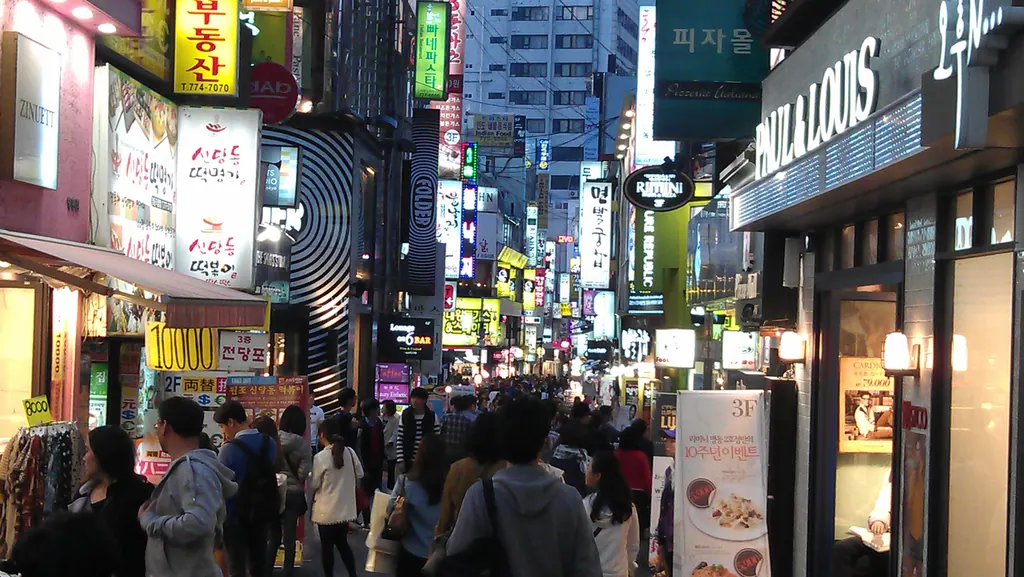
Walk down the main street of Myeongdong in central Seoul on a weekday evening and you pass more cosmetics shops than you can count. Staff at the doors hand out sample sachets, speakers play K-pop, and shoppers wheel half-empty suitcases from store to store. A few subway stops east, the lights stay on in Dongdaemun's wholesale fashion buildings long after midnight, and in Andong, three hours away, woodcarvers still shape the grinning masks used in a village dance that goes back centuries.
South Korea is one of Asia's best countries for shopping, but not always for the reasons people expect. Electronics and international brands are rarely cheaper than at home. What is worth your suitcase space is the skincare, the street fashion, the crafts and a handful of edible souvenirs that are hard to find elsewhere at the same quality and price. This guide covers where to go in Seoul, Busan and the smaller cities, how bargaining works, and how to get the 10% VAT back. For dishes and markets as places to eat, look out for our separate Korea food guide; this one is about what you carry home. Prices are rounded and from 2026.
Is K-beauty really cheaper in Seoul?
For most products, yes, and the selection is far larger than anywhere outside Korea. Sheet masks commonly cost around 1,000-3,000 won (about $0.75-2) each, often less in multipacks, and a full-size serum from a popular Korean brand often costs noticeably less than the same bottle from an overseas retailer. Western luxury brands are a different story and are usually priced much like at home, unless you buy them duty free.
The easiest place to start is Olive Young, the health and beauty chain that dominates the Korean market. According to Korea JoongAng Daily, nearly nine in ten foreign tourists who buy cosmetics in Korea shop there, and the company has well over a thousand stores nationwide. The branches in Myeongdong are set up for visitors, with English signs and staff, and the Myeongdong Town flagship has its own tax refund area. Olive Young runs large sales several times a year, usually in early March, June, September and December, when discounts of 30-50% on selected brands are common.
A few tips that save money and space:
- Compare before you buy. The same product can cost different amounts in Myeongdong's brand shops, Olive Young and the cosmetics floors of department stores. Brand shops often run "buy one, get one" deals.
- Ask for samples. Many shops add free samples, called "service" (seobiseu), to larger purchases. You do not need to ask, but it does no harm.
- Check the dates. Korean cosmetics show a manufacturing or expiry date on the box. Fast sellers in Myeongdong are usually fresh, but it is worth a glance before buying ten of something.
- Mind your carry-on. Liquids over 100 ml go in checked luggage, so pack toners and serums in your suitcase, wrapped in a plastic bag.
Myeongdong is convenient, not unique. Every big shopping street in Korea, from Hongdae in Seoul to Seomyeon in Busan, has its own Olive Young and brand shops, often less crowded.
Which markets in Seoul are worth your time?
Seoul's traditional markets are huge, a little chaotic and very different from each other. Each suits a different kind of shopper.
| Market | Best for | Good to know |
|---|---|---|
| Dongdaemun | Fashion, accessories, fabric and sewing supplies | Retail malls stay open late; wholesale buildings trade mostly at night |
| Namdaemun | Kitchenware, children's clothes, glasses, ginseng, souvenirs | One of Korea's oldest and largest markets; many shops close on Sundays |
| Gwangjang | Silk, hanbok, bedding and vintage clothing | Founded in 1905; textile and hanbok shops are upstairs, mostly closed Sundays |
| Insadong | Crafts, tea, ceramics, paper | A walking street of galleries and craft shops rather than a market |
Dongdaemun: fashion after dark
Dongdaemun is not a single market but a district of more than two dozen shopping buildings around the old East Gate, next to the curving silver Dongdaemun Design Plaza. The retail malls aimed at shoppers, such as Doota Mall, sell Korean fashion labels and copies of trends from the runways at mid-range prices and have traditionally stayed open until late evening or later. The wholesale buildings, where boutique owners from across Asia stock up, come alive at night, typically from around 8 pm until early morning, and most close from Saturday night into Sunday. Hours have changed in several buildings since 2020, so check the specific one before planning a midnight visit. Some wholesale stalls prefer not to sell single pieces, and prices there are given as a number to buyers who know the trade, not haggled over by tourists.
If you sew, knit or make jewelry, the Dongdaemun Shopping Complex (Dongdaemun Jonghap Market) is the place. Its upper floors hold thousands of small stalls selling fabric by the meter, buttons, ribbons, beads, yarn and zippers. A few meters of Korean cotton or linen makes a light, unusual souvenir.
Namdaemun: the practical market
Namdaemun Market, beside Sungnyemun Gate, has been trading since the Joseon era and is where Seoul residents buy the everyday things: kitchen tools, stainless steel chopsticks and spoons, bags, socks, children's clothes, glasses frames and dried goods. It is less polished than Myeongdong and usually cheaper. Look for the alleys selling ginseng and dried seaweed, and the shops stacked with souvenir items at lower prices than in Insadong. Retail shops are mostly open from early morning until early evening, Monday to Saturday.
Gwangjang: look upstairs
Most visitors come to Gwangjang Market for the food alley, which is famous for good reason. But the market started in 1905 as a trading center for cloth, and the textile trade is still there on the upper floor: silk and linen by the bolt, embroidered bedding, and dozens of hanbok shops where you can order the traditional dress made to measure. Gwangjang also has one of Seoul's biggest secondhand clothing sections, a favorite with young Koreans hunting for vintage jackets and denim. The vintage section opens daily, but most fabric and hanbok shops are closed on Sundays.
Where do you find crafts and design?
For traditional crafts in Seoul, start in Insadong. The main street, Insadong-gil, and its side lanes are full of shops selling celadon-style ceramics, brass spoons and chopsticks, calligraphy brushes, hanji paper goods, tea and teaware. Quality ranges from mass-produced to museum standard, so look for workshop names and signed pieces if you want the real thing. Ssamziegil, a building with a spiral walkway of small shops, gathers young designers selling stationery, jewelry and small gifts under one roof.
For contemporary design, head to two neighborhoods with very different moods:
- Hongdae, around Hongik University, is Seoul's student and indie district. Expect affordable clothing, stationery shops, character goods and, on Saturday afternoons in the warmer months, the Hongdae Free Market in Hongik Children's Park, where local artists sell handmade jewelry, prints and crafts.
- Seongsu, east of the center, was long known for leather and handmade shoe workshops. Many old factories now house concept stores, brand showrooms and short-lived pop-up shops. It is the place to see what Korean labels are doing next, though prices are closer to boutique than market level.
How does shopping in Busan compare?
Busan's old downtown, around Nampo-dong, has a cluster of markets within a few minutes' walk of each other, which makes it one of the easiest places in Korea to shop on foot.
Gukje Market, the "international market," grew up after liberation in 1945 and boomed during the Korean War, when Busan was the temporary capital and the market traded in U.S. military goods, relief supplies and imports that came in through the port. Today its covered lanes are organized loosely by trade, with streets of bags, shoes, clothing, hardware, kitchenware and household goods. It is a good place for cheap socks, bags and fun everyday items, and the 2014 film Ode to My Father made it famous across Korea.
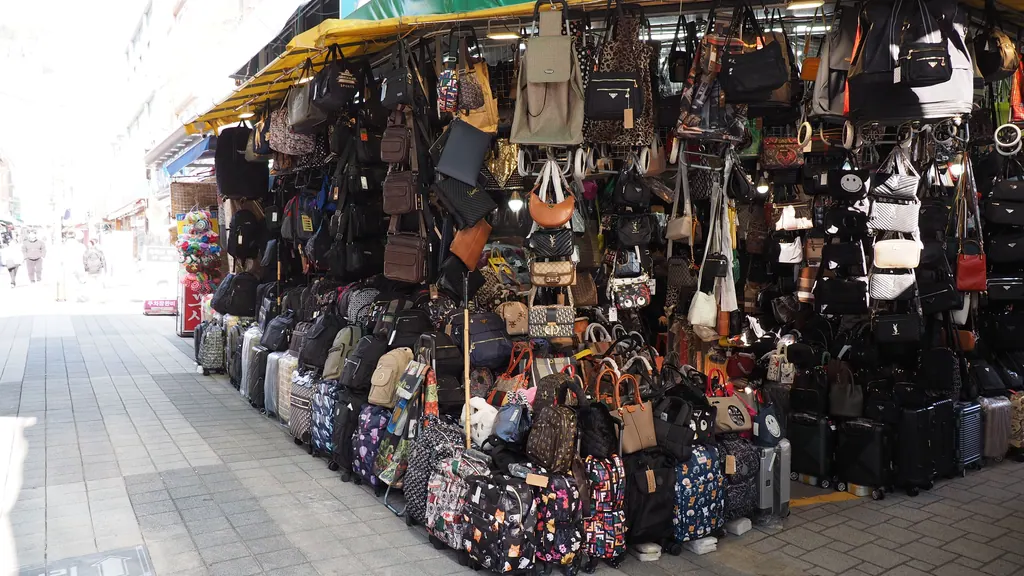
Next door, Bupyeong Kkangtong Market takes its name from the canned goods (kkangtong means tin can) sold there from U.S. bases during the war, and runs a night market in the evenings. BIFF Square, named after the Busan International Film Festival, links the area with the waterfront and is lined with clothing shops and street stalls. On the waterfront itself, Jagalchi Fish Market is mainly for fresh seafood, but its dried seafood stalls sell dried anchovies, squid and seaweed in sealed packs that travel well.
For modern shopping, Busan has the large department stores in Seomyeon and in Centum City, next to Haeundae, plus Olive Young and brand stores on every main street.
What should you buy outside the big cities?
Korea's smaller cities are where traditional crafts are still made, and buying close to the source is part of the pleasure.
Jeonju is the home of hanji, the strong traditional paper made from the bark of the paper mulberry tree. Shops in and around the Jeonju Hanok Village sell hanji notebooks, fans, lamps, boxes and jewelry, and some offer short workshops where you make your own sheet. Hand-pressed fans are light and pack flat. Jeonju's Nambu Market adds a night market on Friday and Saturday evenings, and its upper floor has a youth mall of small shops run by young entrepreneurs.
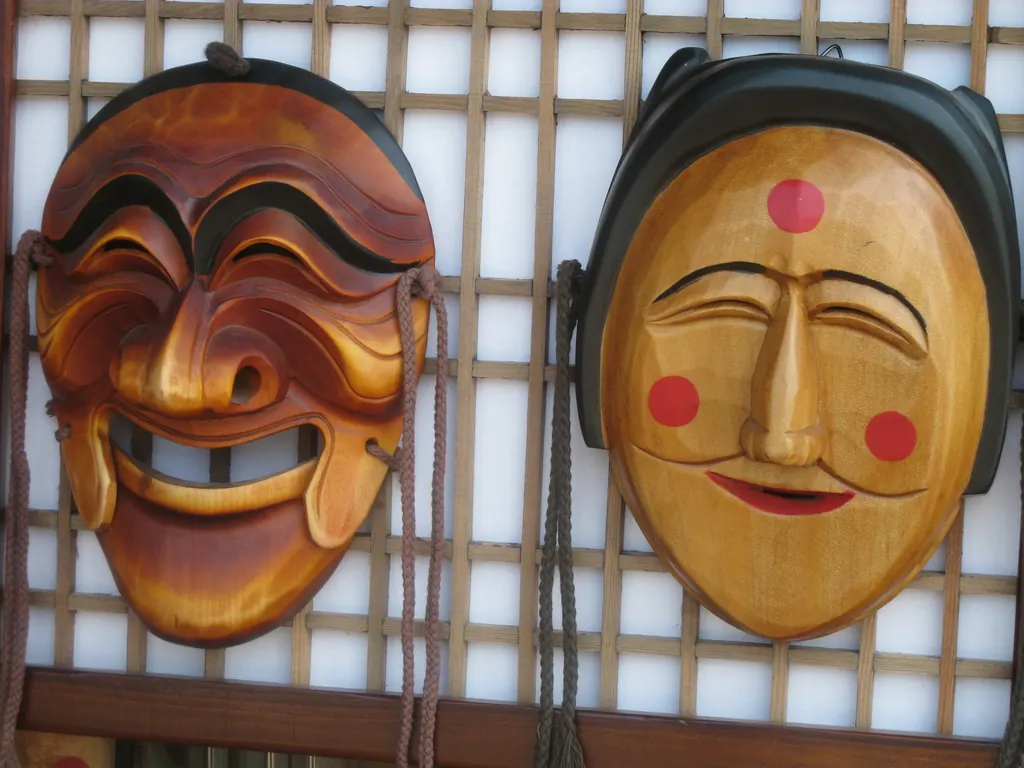
Andong is the place for masks. The wooden Hahoe masks, carved for the Hahoe Byeolsingut Talnori mask dance, are designated a National Treasure, and copies of characters such as the grinning aristocrat and the bride are sold all over Andong and Hahoe Folk Village. Mass-produced painted masks are cheap, while hand-carved pieces by trained artisans cost many times more, so ask who made them. The Hahoe World Mask Museum near the village displays Korean masks alongside masks from around the world, which helps you judge what you are buying. Andong is also known for its traditional distilled soju, a good gift if you have the luggage allowance.
In Gyeongju, the old Silla capital, the classic take-home is Gyeongju bread (also sold as Hwangnam bread), a small round pastry filled with sweet red bean paste, sold in boxes on the main streets. In Gangneung on the east coast, the city's coffee culture has made locally roasted beans from the cafes along Anmok Beach a popular gift, and the Jungang Market sells dried seafood and local snacks.
Can you bargain in Korea?
Less than in many Asian countries. In department stores, Olive Young, brand shops, supermarkets and most shops with printed price tags, the price is fixed, and trying to negotiate will only confuse staff. In traditional markets, street stalls and some independent shops, a modest discount is possible, especially when you buy several items. A polite "kkakka juseyo" (can you give me a discount?) with a smile works better than hard haggling, and the answer is often a small reduction or an extra item thrown in rather than a big cut.
Cards are accepted almost everywhere, including many market stalls, but smaller vendors appreciate cash and are more open to rounding down for it. Carry some 10,000 won notes (about $7) for markets.
How do tax refunds and duty free work?
South Korea adds 10% VAT to most goods, and foreign visitors can get most of it back at stores with a "Tax Free" or "Tax Refund" sign. The main rules, set by the Korean government in 2024 and still in place in 2026:
- Minimum purchase: about 15,000 won (about $11) at a participating store.
- Instant refund at the till: At many shops, including Olive Young's larger branches and department stores, the tax is deducted on the spot when you show your passport. This applies to purchases of up to 1,000,000 won (about $740) at a time, and up to 5,000,000 won (about $3,700) in total per trip. You must leave Korea with the goods within three months.
- Airport refund: For larger purchases, or shops without instant refund, you get a receipt and claim the money at a refund kiosk or counter at the airport before check-in. Customs may ask to see the goods, so do not pack them deep in checked luggage.
After service fees, the money you get back is usually somewhere between 5 and 8% of the price rather than the full 10%. Rules change, so check the tax refund information from the Korea Tourism Organization before a big purchase.
Duty free is a separate system. Downtown duty free stores in Seoul and Busan, such as those in Myeongdong and near Jamsil, let you shop days before your flight with your passport and flight details. You pay in the store, and the goods are handed to you at a pickup counter at the airport after security. It is the best way to buy international luxury brands and premium Korean skincare sets, but less useful for everyday products, which are often cheaper with an instant tax refund on the street.
Before you fly home
A few things to sort out before you pack:
- U.S. customs. Each returning U.S. resident can usually bring back up to $800 in goods duty free. Declare all food, including dried seaweed, ginseng, snacks and dried seafood. Packaged and dried products are generally allowed, while meat products are generally not allowed and may be confiscated. See U.S. Customs and Border Protection's guide before you buy.
- Liquids and alcohol. Soju, makgeolli and cosmetics over 100 ml go in checked luggage. Wrap bottles well.
- Weight. Korean shopping trips tend to end with an extra bag. Many visitors buy a cheap suitcase at Namdaemun or Gukje Market for the trip home.
- Sizes. Korean clothing often runs small and many market items are "free size," so try things on where you can.
If you have room for only a few things, pick the ones Korea does best: a stack of skincare from Olive Young, a piece of hanji or a carved mask from the city where it is made, and something from a Dongdaemun or Seongsu designer that no one at home will have. For more on Korea, see our South Korea destination page, browse more shopping guides such as shopping in Taiwan, or read our practical travel tips before you go.
Frequently asked questions
What is the minimum purchase for a tax refund in South Korea?
In 2026 the minimum was about 15,000 won (about $11) at a store displaying a Tax Free or Tax Refund sign. You need your passport, and the net refund after fees is usually 5-8% of the price.
Is Olive Young cheaper than buying Korean skincare at home?
Usually, yes, especially during Olive Young's big seasonal sales and with the instant tax refund at larger branches. International luxury brands are a different matter and are often better value in duty free stores.
Are Korean markets open on Sundays?
It depends on the market. Many shops in Namdaemun and the fabric and hanbok shops at Gwangjang Market close on Sundays, and most Dongdaemun wholesale buildings close from Saturday night into Sunday. Retail malls and big shopping streets stay open.
Can I pay by credit card at markets in Korea?
Cards are accepted almost everywhere, including many market stalls. Small vendors still prefer cash, and you are more likely to get a small discount when you pay with it.
What are the best souvenirs to buy in South Korea?
Popular choices are skincare and sheet masks, dried seaweed, red ginseng, hanji paper goods from Jeonju, Hahoe masks from Andong and clothing from Korean designers in Dongdaemun, Hongdae or Seongsu.